Overview
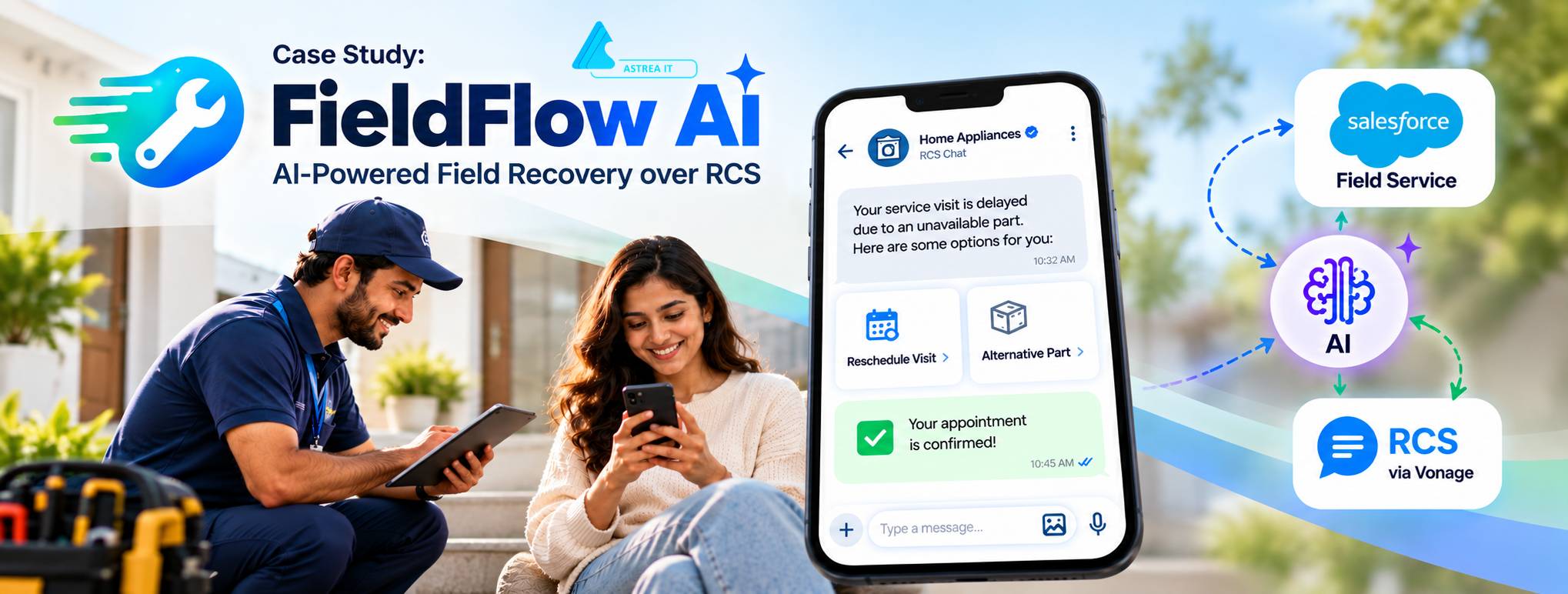
When a home-appliance service visit hits a problem, such as a delayed technician, an unavailable part, or an unexpected equipment issue, FieldFlow AI starts an AI-driven recovery workflow using Salesforce Field Service.
RCS, powered by the Vonage Messages API, is the primary customer channel. Customers review recovery options, select appointment slots, upload photos, approve quotes, and pay in one interactive messaging thread, with no separate app or phone call.
AI analyses the available context and proposes recovery options. Deterministic business rules validate those options before the customer sees them. Sensitive or low-confidence cases need human approval.
| Item | Detail |
|---|---|
| Channel | RCS via Vonage Messages API, with SMS fallback |
| Target | Android, Google Messages, India |
| Status | Built, deployed, and live. Real RCS messages delivered to a real Android phone. |
The Flow
- Failure detection. A service visit becomes at risk because of a technician delay, an unavailable part, or an unexpected equipment issue. Salesforce Field Service triggers the recovery workflow.
- AI context analysis and recovery planning. The system gathers customer, work-order, appointment, technician, inventory, and service-level information. AI combines this with knowledge retrieved from 209 indexed document chunks and proposes recovery options. Deterministic business rules validate each proposal against scheduling, technician skills, inventory, warranty, and service-level requirements.
- Recovery options through RCS. The customer receives an interactive RCS message with validated options as rich cards, carousels, and suggested replies. They review available appointment slots, pick a time, and confirm next steps in the thread.
- Customer input through RCS. Customers can share their location or upload a photo in the conversation, for example a photograph of the appliance label. Automated GPS-to-ETA calculation and image-based model identification are not claimed as completed capabilities in this POC.
- Quote approval and payment. For a chargeable part or service, an RCS rich card presents the quote with three actions: approve and pay, ask a question, or decline. Approving opens a secure Razorpay payment page. Payment confirmation returns through the messaging workflow, and idempotent processing prevents duplicate charges.
- Appointment confirmation. Once validations and customer actions are complete, the customer gets a confirmation through RCS. It can include updated visit details, a calendar action, a direct dial option for the technician, and a service report.
- Human approval and safety. If AI confidence is low, or the case involves a safety concern or warranty dispute, the workflow pauses for human supervisor approval.
- Follow-up and reliability. Cases stay resumable while waiting for customer responses. Delivery and read-status callbacks show message engagement. Queue-based retries, backoff, dead-letter handling, and replay recover from temporary service failures. SMS fallback provides another communication path where supported.
RCS Capabilities Used
All capabilities below are delivered through the Vonage Messages API.
| RCS capability | Role in field recovery |
|---|---|
| Rich cards and action buttons | Present appointment details, recovery options, and quotes |
| Carousels | Let customers browse and select available appointment slots |
| Suggested replies | Enable quick confirmations and decisions |
| Location sharing | Let customers share their location within the conversation |
| Inbound images | Let customers upload photos of appliances or related issues |
| Open-URL action | Open the secure Razorpay payment page |
| Calendar action | Add a confirmed appointment to the customer's calendar |
| Dial action | Enable a direct call to the assigned technician |
| PDF rich card | Provide access to service reports where supported |
| Delivery and read-status callbacks | Track message delivery and customer engagement |
| RCS-to-SMS fallback | Provide an alternative communication path when RCS is unavailable, where supported |
AI and Safety Architecture
A three-level authority model keeps AI recommendations within operational and safety boundaries.
| Level | Responsibility | Authority |
|---|---|---|
| 1. Business rules | Eliminate options that violate scheduling, technician, inventory, warranty, or service-level constraints | Deterministic code |
| 2. AI proposal | Interpret the situation, rank valid recovery options, and draft customer-facing messages | AI, bounded by business rules |
| 3. Human approval | Review risky, low-confidence, or policy-sensitive cases | Human supervisor |
AI uses retrieval-augmented generation (RAG) to pull relevant passages from 209 indexed document chunks. This grounds recommendations in service documentation instead of generated responses alone. Every decision is recorded with its supporting sources, reasoning, confidence score, and policy-validation result, to support auditability.
Enterprise Integration and Operations
- Salesforce Field Service: Provides service and appointment information and supports appointment rescheduling through the deployed integration. It is not a general-purpose Salesforce write integration.
- Inventory: The integration supplies live inventory information to support recovery decisions.
- Payments: Razorpay handles payment processing, with idempotency safeguards against duplicate charges.
- Case management: Workflow state is checkpointed, so cases can pause for customer responses and resume after a server restart.
- Message reliability: Queue-based retries, backoff, dead-letter handling, and replay recover from temporary failures and prevent duplicate processing.
- Observability: Requests, AI decisions, and tool calls are traced end to end for monitoring and auditing.
- Admin copilot: Operations staff can ask natural-language questions across inventory and Salesforce-related data. Inventory information is live, and Salesforce access runs through deployed read-only tools. Salesforce write operations are not generally enabled; rescheduling is supported only through the specific deployed workflow.
Conclusion
FieldFlow AI shows how RCS can support end-to-end recovery of disrupted home-appliance service visits through one interactive messaging experience.
It combines Vonage RCS, Salesforce Field Service, live inventory information, knowledge-grounded AI, deterministic business rules, and human approval. Together they coordinate appointment recovery while keeping recommendations within operational policy.
Customers can review recovery options, share information, approve quotes, make payments, and receive appointment confirmations in the same conversation.