The current corporate race toward artificial intelligence is hitting an unexpected speed bump. While firms are investing heavily in intelligent automation to drive productivity, a quiet but persistent issue is stalling these initiatives: messy data. Without a clear strategy to dedupe Salesforce records, even the most advanced AI tools can become unreliable or, worse, harmful to the business.
Recent data suggests the stakes have never been higher. According to a 2024 Forrester Research report, over 25% of global data and analytics employees estimate annual losses exceeding $5 million due to poor data quality. Some organizations report losses as high as $25 million or more. Furthermore, Gartner predicts that through 2026, organizations will abandon 60% of AI projects that lack "AI-ready" data.
Why Companies Struggle with Salesforce Data
For fast-growing companies, the CRM acts as the "central nervous system" of the go-to-market engine. However, as technology stacks become more complex, interconnecting marketing automation, sales enablement, and ERP systems, multiple entry points for errors are created.
This leads to significant friction across all departments:
- Sales Productivity: Sales professionals spend roughly 70% of their time on non-selling tasks, a figure that has remained largely unchanged for years.
- Forecasting Inaccuracy: 39% of sales professionals claim that poor data quality, such as Salesforce deduplication issues, prevents accurate pipeline forecasting.
- Customer Trust: Inconsistent records lead to marketing teams sending mass emails to the wrong people or support agents failing to understand a customer's history.
As highlighted in this Salesforce data cleansing tool review, manual cleanup is no longer a viable option for modern enterprises. A recent Salesforce study shows that 87% of executives agree that data silos are the primary obstacle to the effective use of AI.
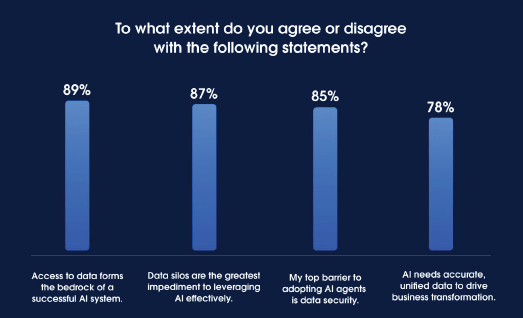
Image source: Salesforce
The 3-Phase Strategy for Sustainable Data Quality
Rather than attempting to fix everything at once, companies should follow structured Salesforce data deduplication steps to turn "data chaos" into an AI-ready foundation. This phased approach ensures steady progress and delivers immediate results.
Phase 1: Address Obvious Exact Matches
The first step in how to dedupe in Salesforce is to target the "low-hanging fruit." These are records that share identical, unique identifiers.
- Filter Criteria: Build filters for Leads and Contacts that share the same email address, full name, and Account.
- Merge Rules: Create rules that prioritize the newest or most complete data so the final merged record is the strongest version. By focusing on these obvious duplicates first, teams can restore trust in the CRM quickly and with minimal effort.
Phase 2: Automate on a Schedule
Once the initial backlog of exact matches is cleared, the focus shifts to maintaining cleanliness. Manually finding and fixing duplicates is a never-ending task.
- Scaling: Use tools to schedule automated Salesforce data-deduping and merging jobs for low-risk duplicates.
- Validation: It is essential to use a "preview mode" to test results before pushing changes live, ensuring that the automation doesn't accidentally merge distinct records. Consistent Salesforce dedupe processes prevent the "cumulative impact" of bad data from building up again.
Phase 3: Prevent Duplicates at the Source
The most sustainable way to manage deduplication rules in Salesforce is to stop errors before they enter the system. This requires controlling the various entry points from external integrations.
- API Integration: Specialized solutions like Cloudingo allow for API-level interception.
- Evaluation: Incoming records from marketing automation, accounting, or ERP systems can be evaluated and deduplicated before they land in Salesforce. This proactive approach to data deduplication in Salesforce ensures the "garbage in, garbage out" cycle is broken.
Auditing for AI Readiness
Before you let an AI bot loose in your CRM, you need to make sure it isn't "hallucinating" based on bad records. While the potential of AI is massive, based on research, the success of these tools depends entirely on the quality of the data they ingest.
Small and medium business (SMB) leaders are already seeing significant returns on their AI investments:
- Efficiency: 90% of SMB leaders report that AI makes operations more efficient.
- Scalability: 87% say AI helps them scale their services.
- Competitive Edge: 86% report that AI improves margins and helps them compete.
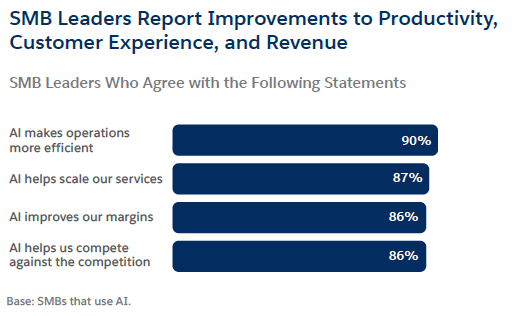
Image source: Salesforce
However, there is a significant catch: if your Salesforce data isn’t reliable, AI will only accelerate your errors. To avoid being part of the 60% of organizations that Gartner predicts will abandon AI projects due to poor data quality, you must verify your "Salesforce hygiene" first. Before deploying AI bots or predictive models, organizations must verify their Salesforce hygiene. An AI readiness checklist should include:
1. Required Field Standards
Think of AI like a high-end chef; it can only cook a five-star meal if you provide the right ingredients.
- Review Key Objects: Audit your Leads, Contacts, and Opportunities to identify fields critical for AI logic, such as Industry, Job Title, or Annual Revenue.
- Fill the Gaps: Use field completeness tools to identify where data is missing and implement workflows to ensure these fields are populated moving forward.
2. Picklist Uniformity
Inconsistent data acts like a "language barrier" for AI.
- Standardize Categories: If your "Industry" picklist has six different versions of “Healthcare” (e.g., Health Care, HC, Healthcare), the AI will treat them as distinct, unrelated groups.
- Normalize Values: Ensure your Lead Source, Industry, and State/Country picklists are normalized to ensure clean categories for segmentation and predictive modeling.
3. Duplication Thresholds
Duplication is the fastest way to skew AI forecasts and reporting.
- Define Match Criteria: Determine what technically constitutes a duplicate in your org, for instance, should "IBM" and "International Business Machines" be merged?.
- Test Patterns: Use preview modes in your Salesforce data deduplication tools to see how match criteria behave before applying them to your entire database.
4. Integration Readiness
Your CRM doesn't live on an island; it is fed by marketing automation, ERPs, and product usage platforms.
- Sync Health: Ensure all integrated tools are syncing cleanly with Salesforce without creating recursive loops or duplicate records.
- Clean at the Source: Using a tool like Cloudingo allows you to use API integrations to intercept and clean data from external sources before it ever hits your Salesforce org.
Conclusion
For the modern business, deduping Salesforce data is no longer a background administrative task; it is a core growth strategy. Whether you are preparing for a major AI rollout or simply trying to improve the accuracy of your sales forecasts, the foundation remains the same. Clean, deduplicated records are the only way to ensure that your technology investments actually deliver on their promise of productivity and growth.
For any queries please reach out to support@astreait.com