Manufacturers relying on Salesforce Manufacturing Cloud’s Rebate Management often face a familiar end-of-quarter scramble. Distributors submit claims late, proof-of-sale (POS) data arrives fragmented, and edge-case tier attainment triggers audit bottlenecks and delayed payouts. The consequence is twofold: strained distributor relationships and lost revenue from missed mid-quarter upsell windows.
An enhanced, Proactive Rebate Payout Optimization Engine bridges this gap. By uniting native Manufacturing Cloud rebate architecture with custom invocable Apex velocity modeling and Agentforce reasoning, manufacturers can continuously predict tier attainment and empower sales reps with concrete, mid-period upsell actions before the quarter closes.
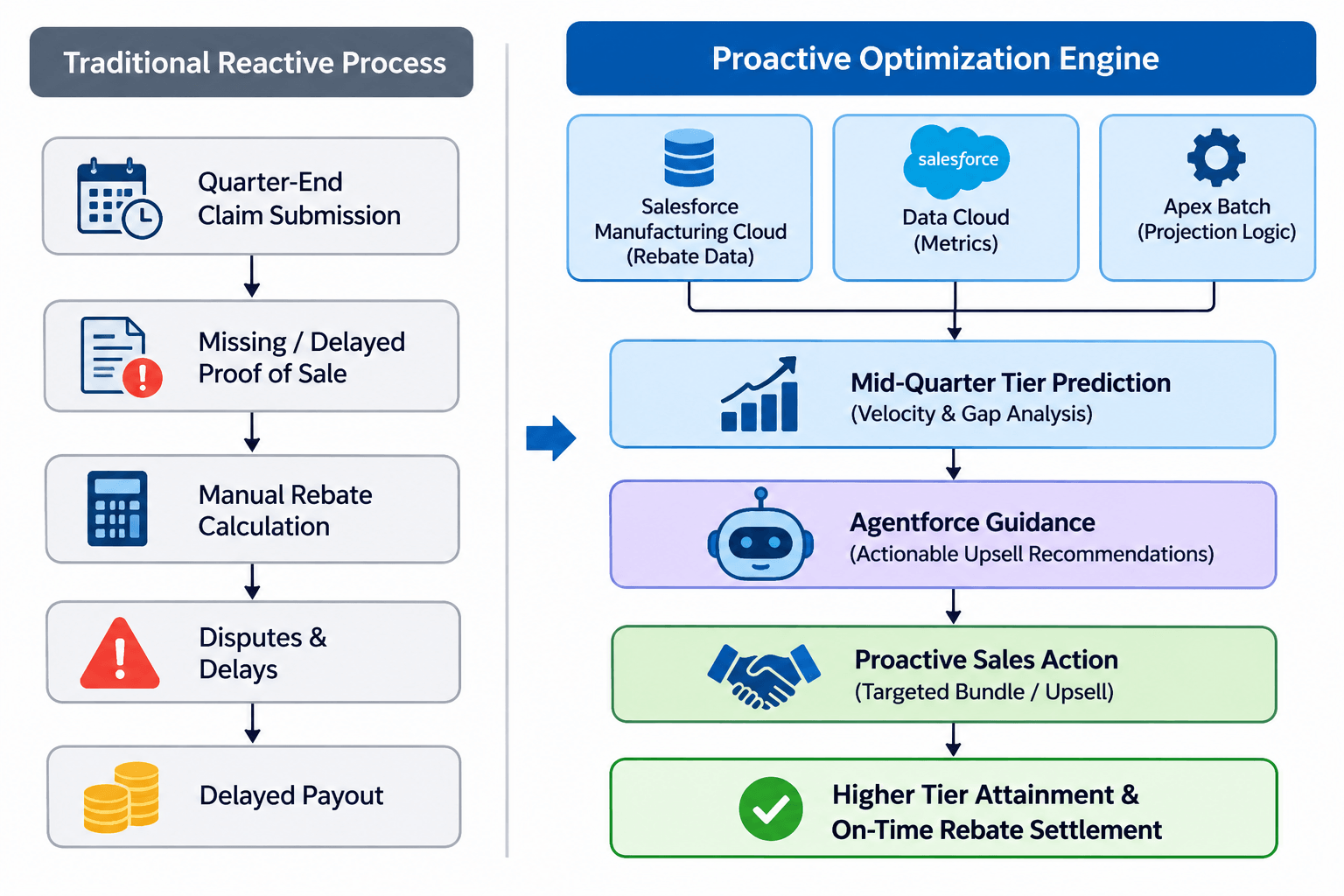
The Core Challenge in Manufacturing Cloud Rebate Management
Manufacturing Cloud’s standard Rebate Management module calculates payouts against defined tier structures—typically volume-based. Objects such as RebateProgram, RebateProgramMember, and ProgramRebateTypePayout handle the core logic effectively for straightforward scenarios.
In practice, several friction points emerge:
- Distributors frequently submit claims near or after quarter-end.
- Missing or delayed proof-of-sale documentation triggers manual reviews and audit discrepancies.
- Sales teams lack real-time visibility into how close a partner is to the next rebate tier.
- Opportunities to influence order volume mid-quarter are missed because insights arrive too late.
These issues compound cash-flow pressure for manufacturers and erode trust with the distributor network.
The Enhancement Solution: A Proactive Rebate Payout Optimization Engine
The solution continuously evaluates order trajectories, projects quarter-end tier attainment, and surfaces actionable recommendations to sales representatives—before the quarter closes.
It delivers two primary capabilities:
- Mid-quarter prediction of rebate tier attainment based on current order velocity and remaining days in the period.
- Agentforce-powered prompts that give sales reps concrete upsell guidance. Example: “Customer X is 120 units away from achieving Tier 2 (15% rebate). Offer a 50-unit bundle discount to push them over.”
By intervening early, organizations reduce last-minute claim volume, improve data completeness, and actively help partners reach higher tiers—creating a win-win for both manufacturer and distributor.
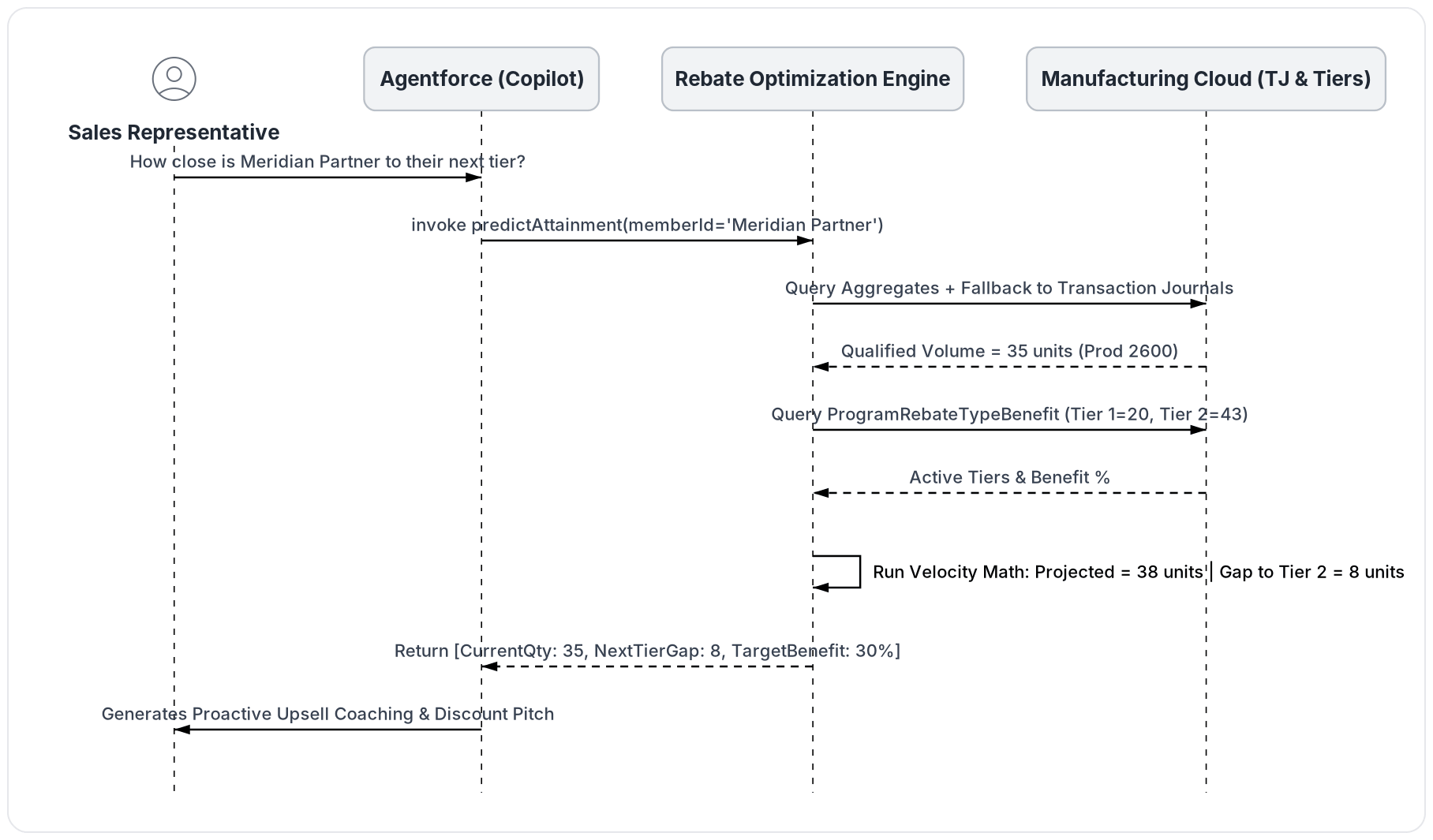
End to End processing flow
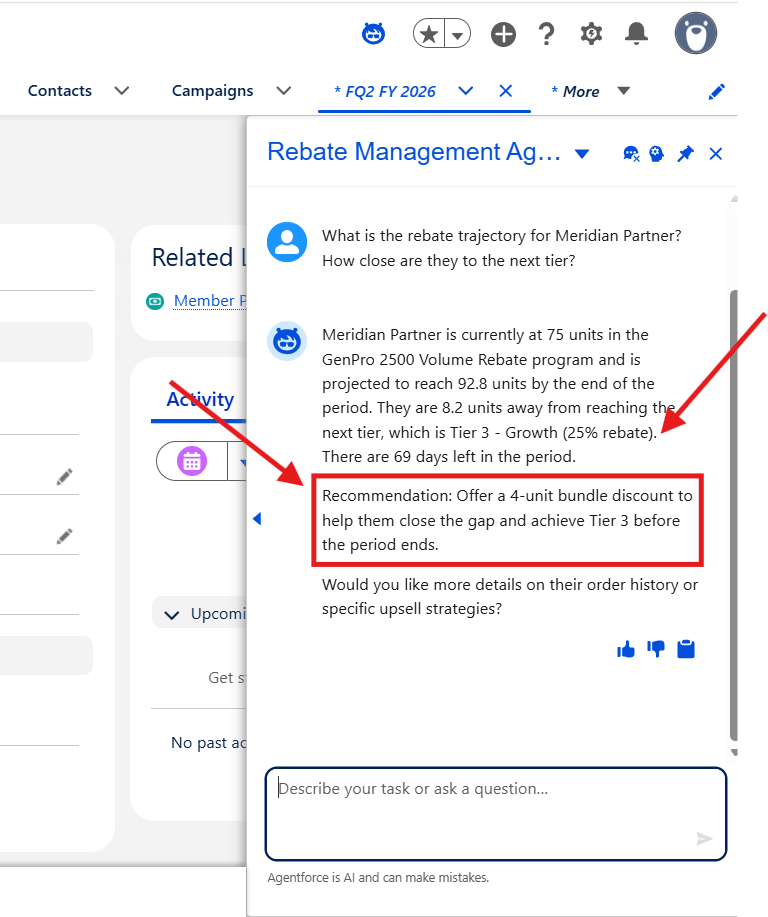
Agentforce Rebate Management Agent translating complex rebate trajectory math into an actionable commercial upsell recommendation for the sales rep.
Technical Implementation Highlights
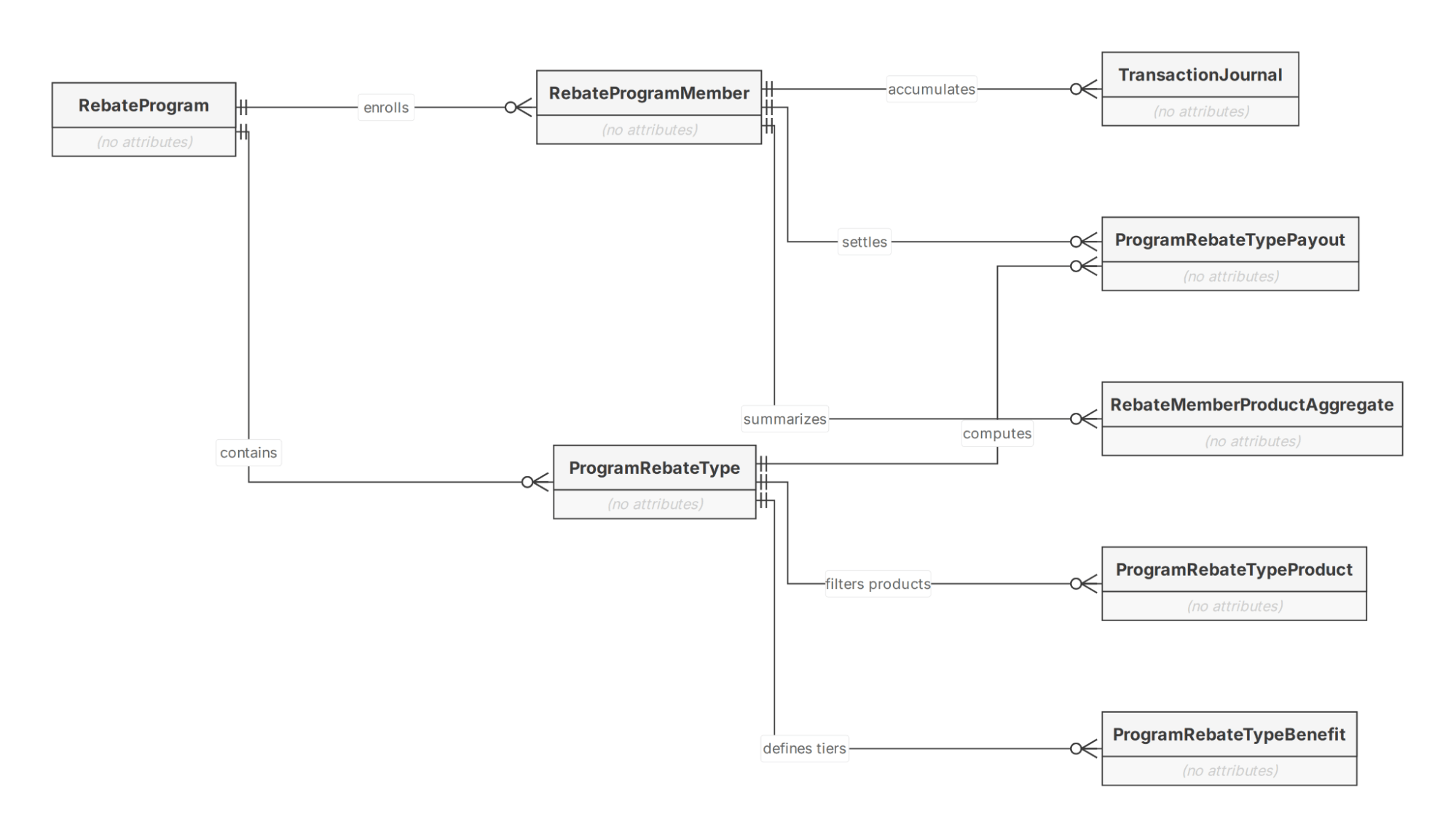
The architecture strictly adheres to native Salesforce Manufacturing Cloud Rebate Management standards ensuring zero schema bloat, zero custom object overhead, and seamless compatibility with standard platform releases.
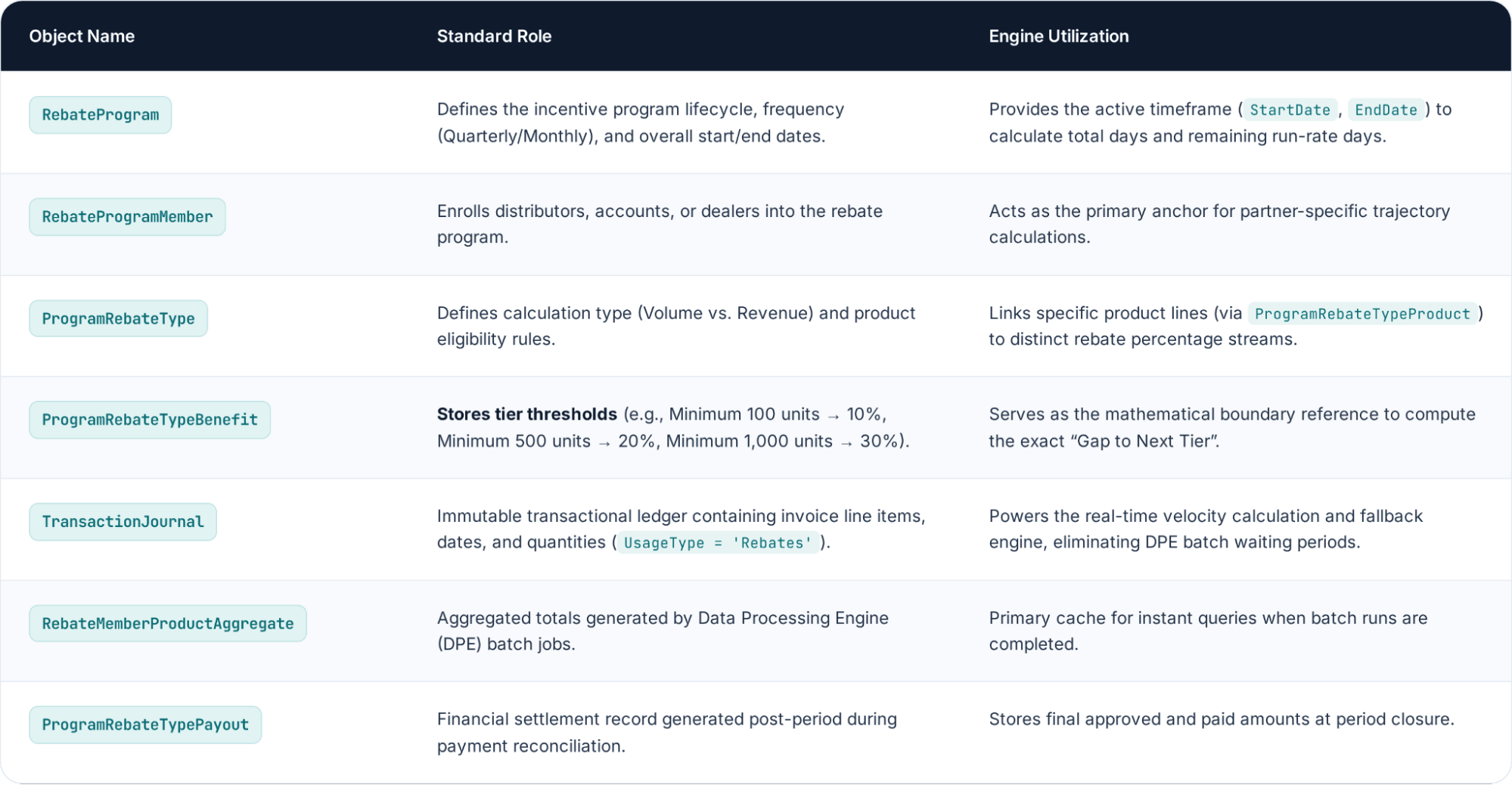
Solution ER Diagram (Entity-Relationship)
Production-Ready Invocable Apex Engine
The calculation engine is encapsulated in an optimized, bulkified Invocable Apex class. It can be invoked directly by Agentforce actions, Screen Flows, or scheduled Apex Batch jobs.
Note → This is not a complete code this is just a main part of the code.
public with sharing class RebateOptimizationEngine {

    public class RebateRequest {
        @InvocableVariable(label='Member ID, Name, or Account' description='Account Name or Member ID to evaluate' required=true)
        public String memberId;
    }

    public class RebateProjectionResult {
        @InvocableVariable(label='Member Name') public String memberName;
        @InvocableVariable(label='Rebate Program Name') public String programName;
        @InvocableVariable(label='Rebate Type Name') public String rebateTypeName;
        @InvocableVariable(label='Current Attainment Qty') public Decimal currentAttainment;
        @InvocableVariable(label='Projected Quarter-End Qty') public Decimal projectedAttainment;
        @InvocableVariable(label='Current Tier Achieved') public String currentTier;
        @InvocableVariable(label='Units Needed for Next Tier') public Decimal unitsToNextTier;
        @InvocableVariable(label='Next Tier Reward') public String nextTierBenefit;
        @InvocableVariable(label='Agentforce Coaching Prompt') public String recommendation;
    }

    @InvocableMethod(label='Calculate Tier Trajectory'
                     description='Evaluates mid-quarter order velocity, predicts tier attainment, and generates Agentforce sales coaching.')
    public static List<RebateProjectionResult> predictAttainment(List<RebateRequest> requests) {
        List<RebateProjectionResult> results = new List<RebateProjectionResult>();
        if (requests == null || requests.isEmpty()) return results;

        Set<String> searchKeys = new Set<String>();
        for (RebateRequest req : requests) {
            if (String.isNotBlank(req.memberId)) searchKeys.add(req.memberId.trim());
        }

        List<RebateProgramMember> members = [
            SELECT Id, Name, AccountId, Account.Name, RebateProgramId, RebateProgram.Name,
                   RebateProgram.StartDate, RebateProgram.EndDate
            FROM RebateProgramMember
            WHERE (Id IN :searchKeys OR Name IN :searchKeys OR Account.Name IN :searchKeys)
              AND MemberStatus = 'Active'
              AND RebateProgram.Status = 'Active'
        ];

        if (members.isEmpty()) return results;

        Map<Id, List<ProgramRebateType>> programTypesMap = getProgramTypesWithBenefits(members);

        for (RebateProgramMember member : members) {
            List<ProgramRebateType> rebateTypes = programTypesMap.get(member.RebateProgramId);
            if (rebateTypes == null || rebateTypes.isEmpty()) continue;

            Date startDate = member.RebateProgram.StartDate;
            Date endDate = member.RebateProgram.EndDate;
            Integer totalDays = Math.max(1, startDate.daysBetween(endDate));
            Integer daysElapsed = Math.max(1, startDate.daysBetween(Date.today()));

            for (ProgramRebateType prt : rebateTypes) {
                Decimal currentQty = fetchAttainmentVolume(member.Id, prt.Id, startDate, endDate);

                Decimal dailyVelocity = (currentQty / daysElapsed);
                Decimal projectedQty = (dailyVelocity * totalDays).setScale(0, System.RoundingMode.HALF_UP);

                TierEvaluation eval = evaluateTierGap(prt.ProgramRebateTypeBenefits, currentQty, projectedQty);

                RebateProjectionResult res = new RebateProjectionResult();
                res.memberName = member.Account.Name != null ? member.Account.Name : member.Name;
                res.programName = member.RebateProgram.Name;
                res.rebateTypeName = prt.Name;
                res.currentAttainment = currentQty;
                res.projectedAttainment = projectedQty;
                res.currentTier = eval.currentTierName;
                res.unitsToNextTier = eval.unitsToNextTier;
                res.nextTierBenefit = eval.nextTierBenefit;

                if (eval.unitsToNextTier > 0) {
                    res.recommendation = 'Customer is only ' + eval.unitsToNextTier + ' units away from ' +
                                         eval.nextTierBenefit + '. Recommend offering a targeted bundle to bridge the gap before quarter-end.';
                } else {
                    res.recommendation = 'Customer is on track to secure maximum tier attainment (' + eval.currentTierName + ').';
                }
                results.add(res);
            }
        }
        return results;
    }
}
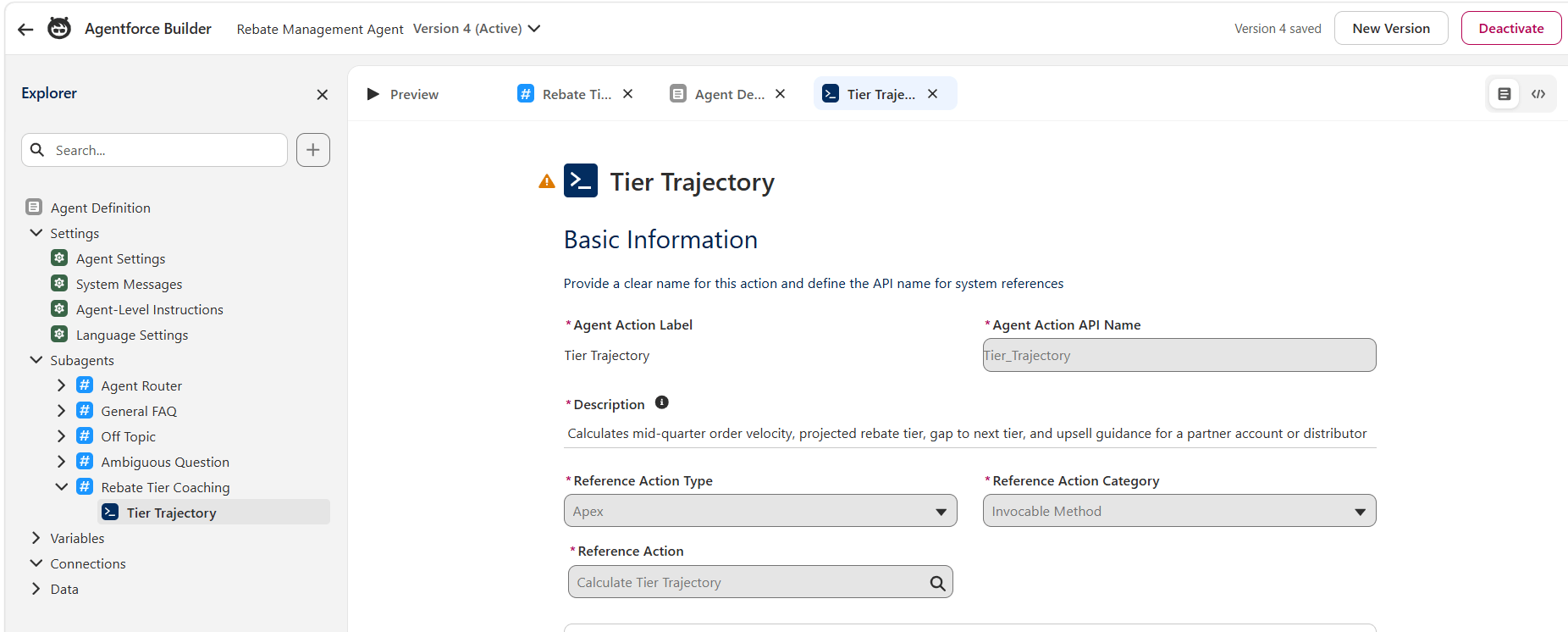
Exposing the Apex Invocable Engine as a native Agentforce Action
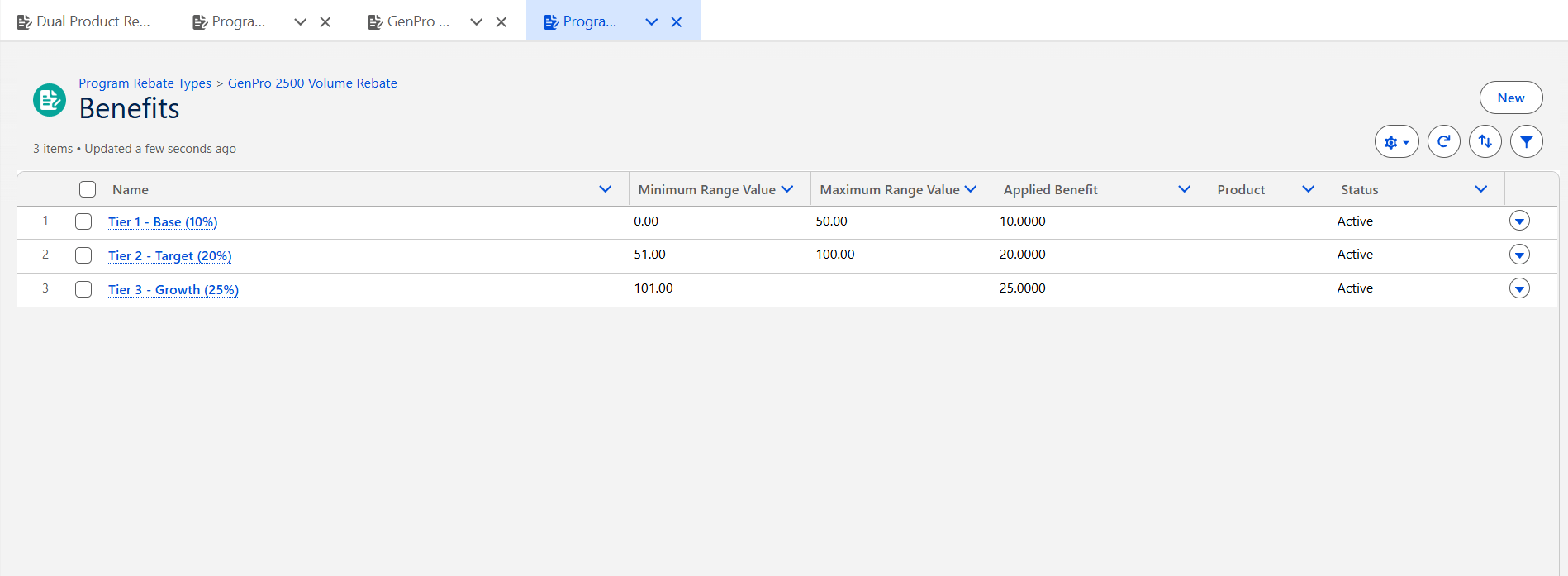
Standard ProgramRebateTypeBenefit tier definitions configuring the exact qualification thresholds evaluated by the Apex engine.
Integration with Agentforce
Agentforce consumes the projection results and applies reasoning to craft context-aware recommendations.
Batch Apex jobs can run on a scheduled basis (daily or weekly) to refresh projections for all active members, while real-time invocability supports on-demand checks from the Salesforce UI or agent interfaces.
Business Outcomes and Value
Organizations implementing this approach typically realize:
- Earlier visibility into at-risk or near-miss rebate members.
- Higher attainment of target tiers through timely, data-driven upsell actions.
- Reduced volume of incomplete or disputed end-of-quarter claims.
- Cleaner audit trails because proof-of-sale data is encouraged and captured earlier.
- Stronger distributor relationships driven by proactive support rather than purely transactional rebate processing.
Sales teams move from reactive claim chasing to consultative partnering. Finance and operations teams gain more predictable payout forecasting.
Conclusion
Manufacturing Cloud Rebate Management provides a solid foundation. Layering predictive trajectory analysis and Agentforce reasoning transforms it into a proactive optimization engine. Manufacturers can reduce bottlenecks, improve data quality, and actively help their partners succeed, turning rebate programs into a genuine competitive advantage.
By shifting from reactive claim processing to mid-quarter intervention, organizations create cleaner data, stronger partner relationships, and more predictable financial outcomes. The combination of standard Manufacturing Cloud objects, targeted Apex automation, and Agentforce delivers a practical path to more intelligent rebate management.