Case Study: Salesforce, SAP, and eCommerce Integration Architecture
Client is the Largest Industrial Fasteners Manufacturer in India.
Business Problem
The client has been using Salesforce, SAP and eCommerce platforms to manage their business operations with each platform fulfilled a distinct strategic function:
- Salesforce operated as the primary CRM and analytics hub
- SAP functioned as the central operational and transactional backbone, and
- E-Commerce application served as the customer-facing digital storefront for product browsing and online purchasing.
Having different systems for their business operations created the challenge of disjointed information, long operating time to get the required data and decreased customer support and satisfaction.
Astrea IT Solution
Astrea IT team worked with the client stakeholders holding several discovery calls to understand the requirements. The team laid the plan to stakeholders on designing a unified, enterprise-grade data integration architecture that seamlessly connected core client business platforms—Salesforce, SAP, and the E-Commerce portal.
To ensure robust, real-time synchronization across all platforms, we introduced a JS-ETL (Extract–Transform–Load) server as the central integration layer and orchestration engine.
Within this architecture, Salesforce was primarily responsible for managing customer information, sales records, and analytical dashboards. Whenever new entities—(such as accounts or orders)—were created in Salesforce, the ETL server transmitted these records to SAP. SAP validated and processed the incoming data and returned system-generated identifiers (e.g., SAP Record IDs). These IDs were then updated back into Salesforce, enabling end-to-end traceability and ensuring data consistency across both systems.
The E-Commerce platform consumed product catalog and pricing data from SAP, while receiving additional marketing and CRM enrichments from Salesforce. When customers placed orders through the E-Commerce site, the order details were propagated simultaneously to Salesforce and SAP via the ETL server. To maintain a unified identity and eliminate duplication across the ecosystem, we adopted a standardized, tri-identifier model consisting of:
- Salesforce Record ID
- SAP Record ID
- E-Commerce Record ID
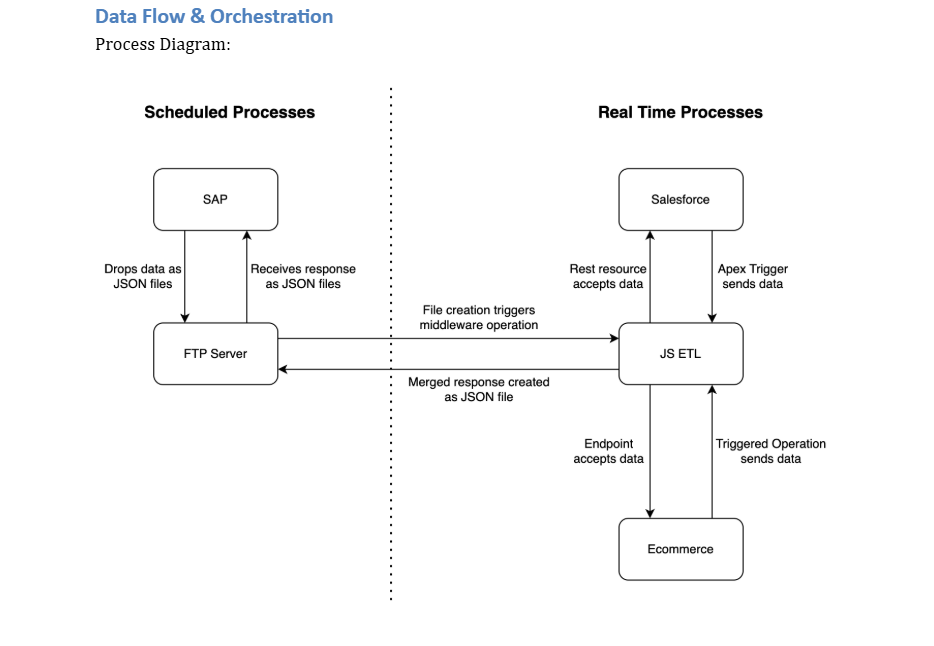
This approach ensured complete transparency, data integrity, and reliable cross-system reconciliation.
The JS-ETL server served as the middleware cornerstone of the entire landscape. It collected data payloads from all three platforms, performed transformations, enforced business rules, and routed information to the appropriate destination system based on predefined logic. It also managed error handling, retry mechanisms, and comprehensive logging. By decoupling the systems from each other, the ETL layer enabled clean, consistent, and near real-time data flow throughout the organization.
Outcome
- Significantly enhanced operational efficiency
- Improved data accuracy
- Elevated the overall customer experience
- Fully synchronized, cohesive ecosystem
Need support with a similar project?
Contact Details
- +91-9818348569
- support@astreait.com