Introduction
In manufacturing, a warranty claim is more than a request for reimbursement. It is a potential signal of a product defect, a component quality issue, or a manufacturing process that needs attention.
Yet, in many organizations, warranty management and product engineering operate in separate systems. Customer service teams process claims, distributors submit warranty requests, and field service technicians record repair details. Meanwhile, engineering and product quality teams investigate defects using separate tools, reports, and data sources.
The result? A recurring component failure might affect hundreds of customers before the engineering team recognizes the pattern.
What if every warranty claim could become part of an automated quality feedback loop—connecting service operations directly to engineering?
In this article, we explore a solution built around Salesforce Manufacturing Cloud for Service that connects warranty claims, asset information, and defect trends to an automated engineering escalation process.
The objective is straightforward: identify emerging component quality issues earlier and turn warranty data into actionable engineering intelligence.
1. The Problem: Warranty Claims That Never Reach Engineering in Time
Consider a manufacturer of industrial equipment that supplies thousands of machines through distributors. Over a period of several weeks, service teams begin receiving warranty claims for a particular hydraulic component. Each claim is processed individually. Some are approved, replacement parts are shipped, and repairs are completed.
From the service team's perspective, the cases are resolved.
From the engineering team's perspective, however, a potentially serious quality issue is developing.
The claims might share several characteristics:
- The affected machines use the same component model.
- The components belong to a specific production batch or serial-number range.
- The failures occur within a similar operating period.
- The repair descriptions point to the same underlying symptom.
Without a mechanism to correlate this information, each claim remains an isolated transaction.
reporting can delay identification of the underlying defect. Engineering teams may discover the pattern only after significant warranty costs have accumulated or additional customers have experienced failures.
The missing capability is a closed-loop connection between warranty operations and product quality management.
2. The Solution: An Asset-Centric Quality Feedback Loop
This solution uses Salesforce as the operational foundation for capturing warranty activity and identifying recurring defect patterns.
Instead of evaluating claims only as individual requests, the solution correlates claim information with the affected assets, component identifiers, production batches, and claim dates.
When a component batch exceeds a configurable defect threshold within a defined time window, the system automatically initiates an engineering investigation in Jira.
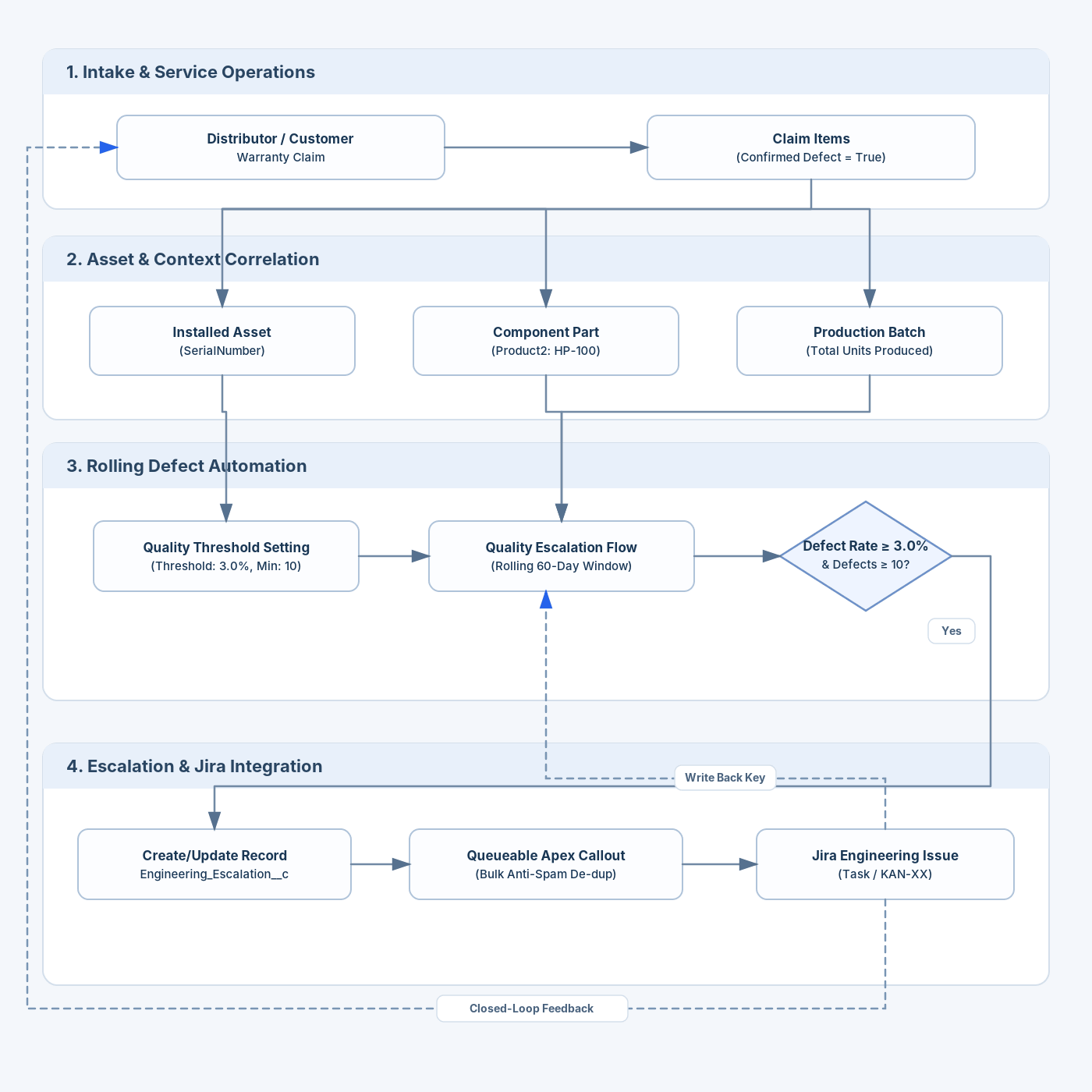
High-Level Process Flow:
- Claim Submission: A distributor, customer, or field service team submits a warranty claim.
- Contextual Correlation: The claim and its associated claim items are linked to the relevant asset, component, and production batch information.
- Automated Defect Evaluation: Automation evaluates recent confirmed defect claims associated with the same component or production batch over a rolling 60-day window.
- Threshold Check & Rate Calculation: The system calculates the defect rate against total units produced. If the defect rate exceeds the configured threshold (e.g., 3.0%), an engineering escalation record is created in Salesforce.
- Jira Dispatch: Diagnostic evidence, defect counts, batch numbers, and claim references are automatically dispatched to Jira as an engineering Task.
- Closed Feedback Loop: Engineering investigates the issue in Jira and records its findings, which link back to Salesforce, establishing a closed feedback loop between service and quality teams.
This approach changes warranty management from a reactive administrative process into an early-warning mechanism for product quality.
3. Understanding the Salesforce Data Model
The solution builds on the core records involved in warranty management, asset tracking, and service operations:
- Claim: The Claim record represents a warranty or other claim submitted for evaluation and processing. It provides the overall context for the claim, including its status, associated customer or asset, and relevant claim information.
- Claim Item: Claim Item records represent the individual items, components, or claim details associated with a claim, depending on the organization's Salesforce configuration. This level of detail is important when one claim involves multiple components or replacement parts. The automation needs to identify which specific component is associated with the reported defect rather than counting every claim as an equivalent failure.
- Asset: The Asset record represents the customer's installed product or equipment. By connecting claims to assets, the manufacturer can investigate whether failures are concentrated in a particular product model, installed population, component family, or serial-number range. For this solution, the asset and component identifiers provide the foundation for grouping defect events.
- Asset Warranty: Asset Warranty information establishes the applicable warranty coverage for an asset. This helps the organization distinguish warranty-related activity from other service events and apply the appropriate eligibility and business rules.
- Work Order: Work Orders represent service work associated with an asset, such as inspection, repair, or replacement. Linking warranty claims to work orders can enrich the quality investigation with repair findings, replaced components, technician observations, and service history.
Implementation Extension: To enable automated defect rate calculations against manufacturing lots and Jira tracking, two custom objects complement the standard model:
- Production_Batch__c: Tracks manufacturing lot codes, total units produced, and release dates.
- Engineering_Escalation__c: Stores calculated defect rates, sample sizes, and the bidirectional Jira ticket key (Jira_Issue_Key__c).
4. Defining the Defect Detection Rule
The central business rule determines when a pattern of failures is significant enough to warrant engineering investigation. For example, suppose a manufacturer wants to monitor a specific component batch for 60 days and raise an alert when the defect rate exceeds 3%.
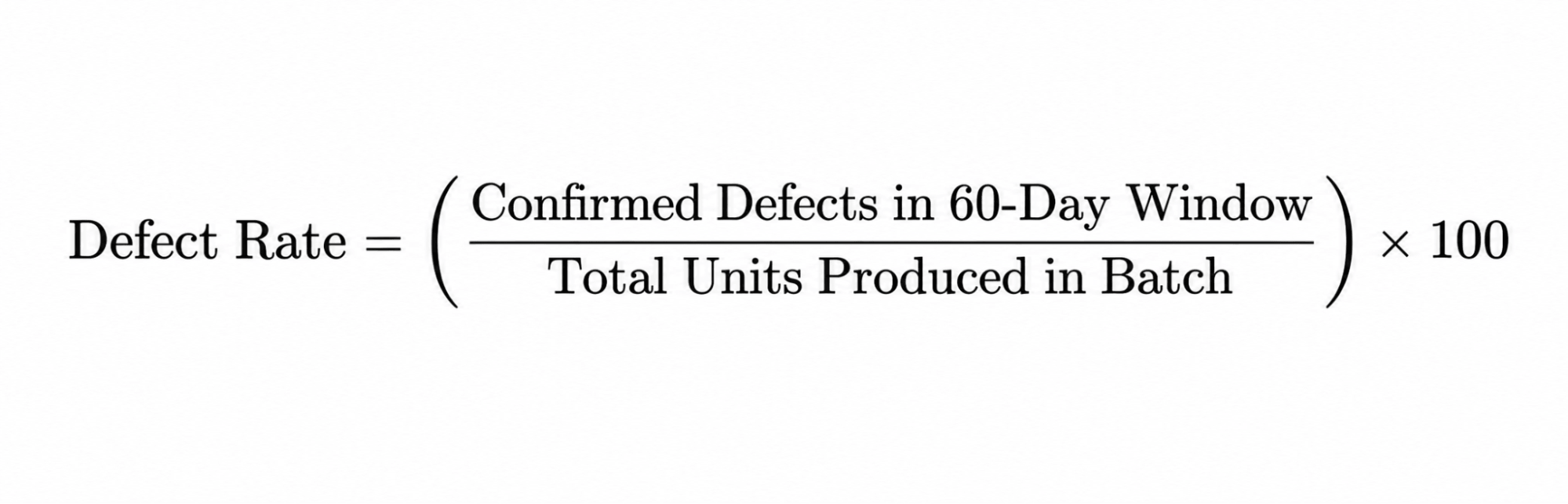
The calculation can be expressed as:
Defect rate = Confirmed defect events ÷ Eligible units exposed to the same component or batch × 100
The system triggers an escalation when:
Defect rate > 3% within the rolling 60-day window
Consider the following illustrative scenario:
| Metric | Example value |
| Eligible units in the monitored batch | 1,000 |
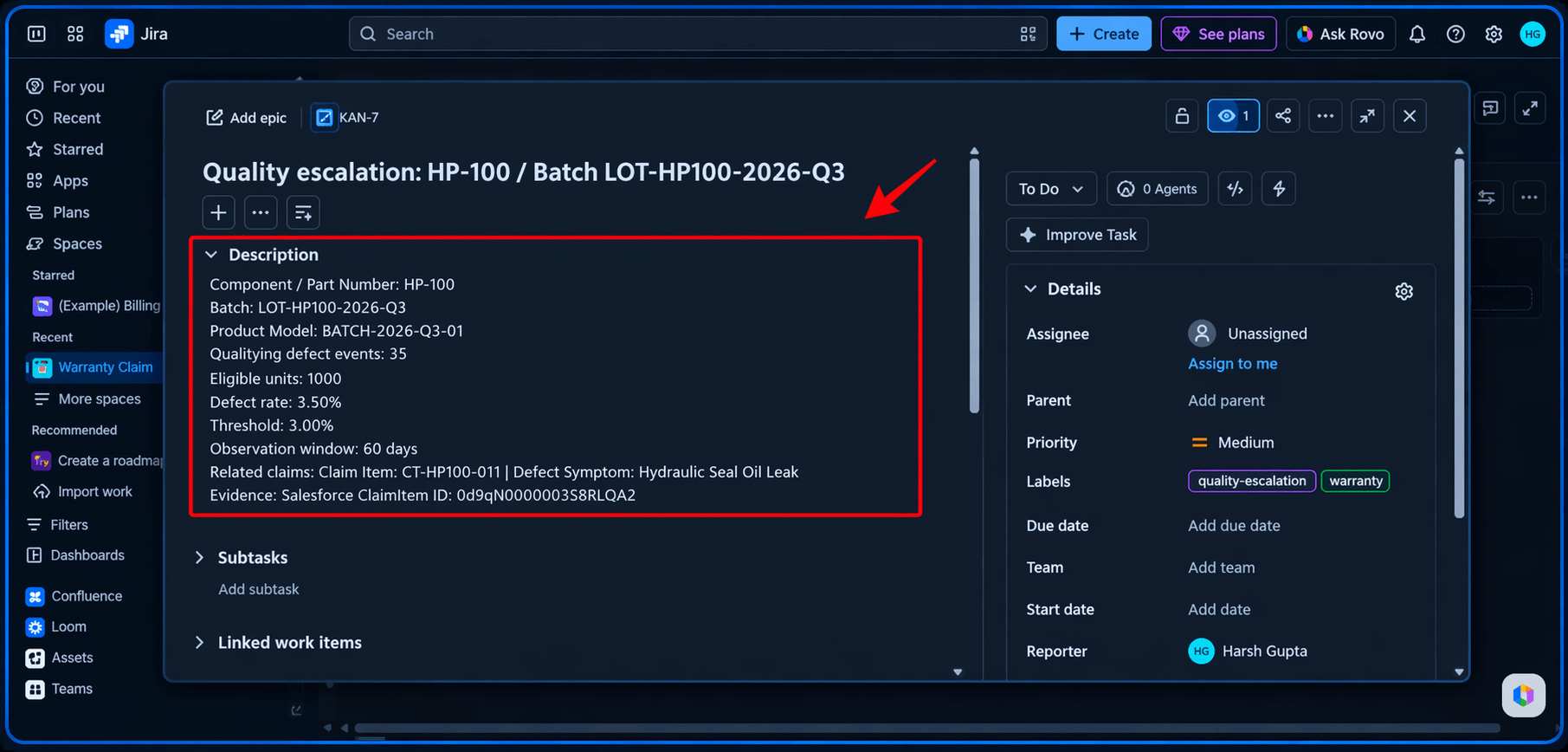
| Confirmed defect events within 60 days | 35 |
| Calculated defect rate | 3.5% |
| Escalation threshold | 3% |
| Result | Engineering escalation |
Because the defect rate exceeds the threshold, the system initiates an engineering investigation.
The denominator is important. Counting 35 claims without knowing whether the affected batch contains 100 units or 10,000 units does not provide a meaningful defect rate.
If reliable installed-population or production-batch data is unavailable, an initial implementation could monitor claim frequency instead. In that case, the rule should be described as a claim-volume threshold rather than a true defect rate.
The threshold, observation window, and minimum sample size should be configurable to suit the manufacturer's quality-management policies.
5. Proposed Technical Architecture
The solution combines Salesforce record automation, rolling-window aggregation, and integration with an external engineering platform.
Step 1: Capture warranty claim activity
When a Claim Item is created or updated, the automation identifies the associated claim, asset, component, and production batch.
It checks whether the record represents a qualifying defect event (Is_Confirmed_Defect__c = true). For example, a submitted claim might not count until it has been validated or confirmed, depending on the manufacturer's process.
This prevents duplicate submissions, rejected claims, and unrelated warranty requests from distorting the quality metrics.
Step 2: Correlate claims by component and batch
The system groups qualifying defect events using a defined combination of identifiers, such as:
- Component or part number
- Component serial number or production batch
- Asset model
- Claim date or confirmed defect date
The grouping logic must match the manufacturer's traceability requirements. A product model alone may be too broad, while a batch identifier may provide a much more precise signal.
Step 3: Calculate the rolling 60-day defect rate
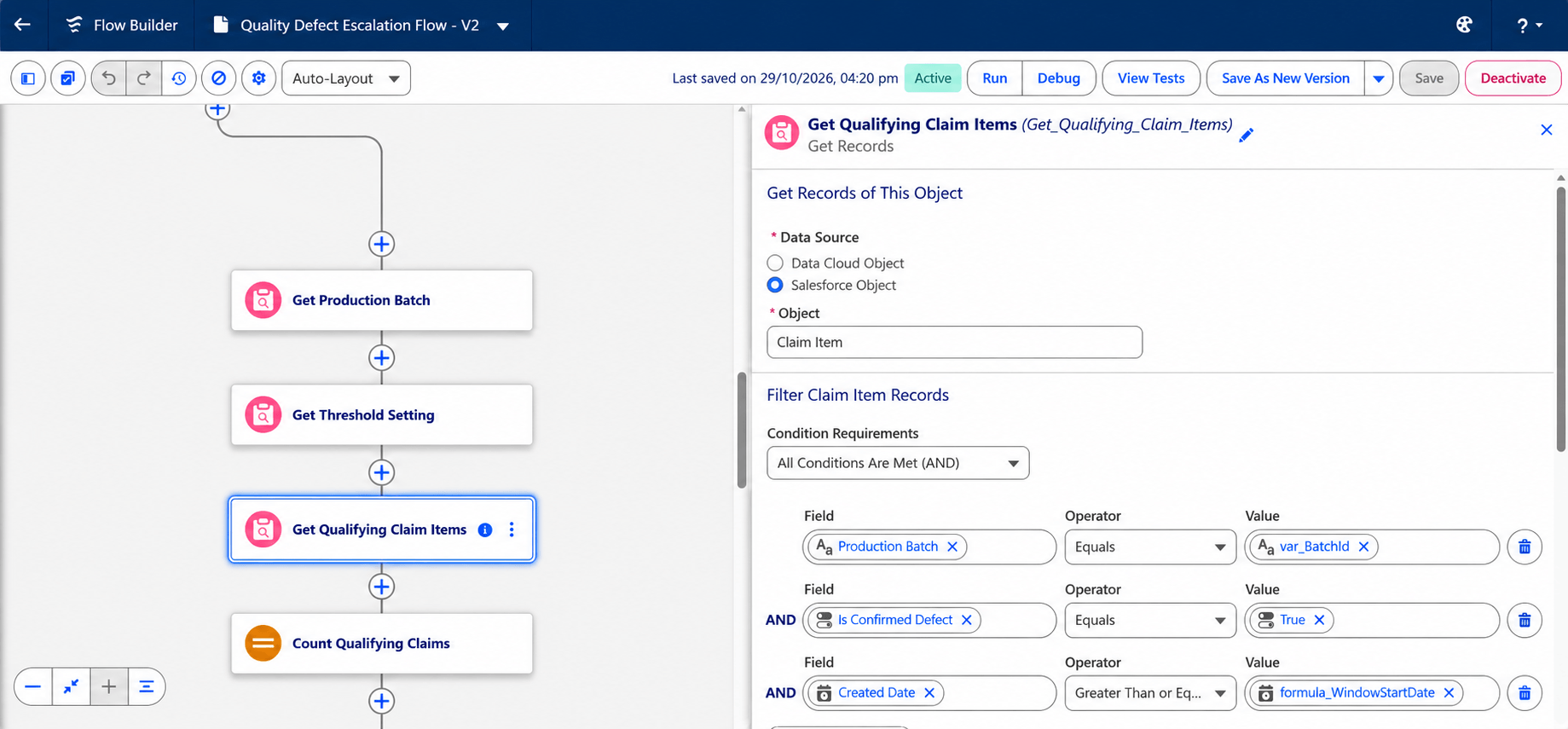
The automation evaluates qualifying events in the relevant time window and calculates the defect rate.
A custom aggregation process maintains the required counts and rates:
- Why standard Roll-Up Summaries are insufficient: A standard Salesforce roll-up summary field is not, by itself, sufficient for a rolling 60-day calculation. Standard roll-up summaries aggregate related records according to supported relationship and filter rules; they do not automatically remove records as they age beyond a moving date window.
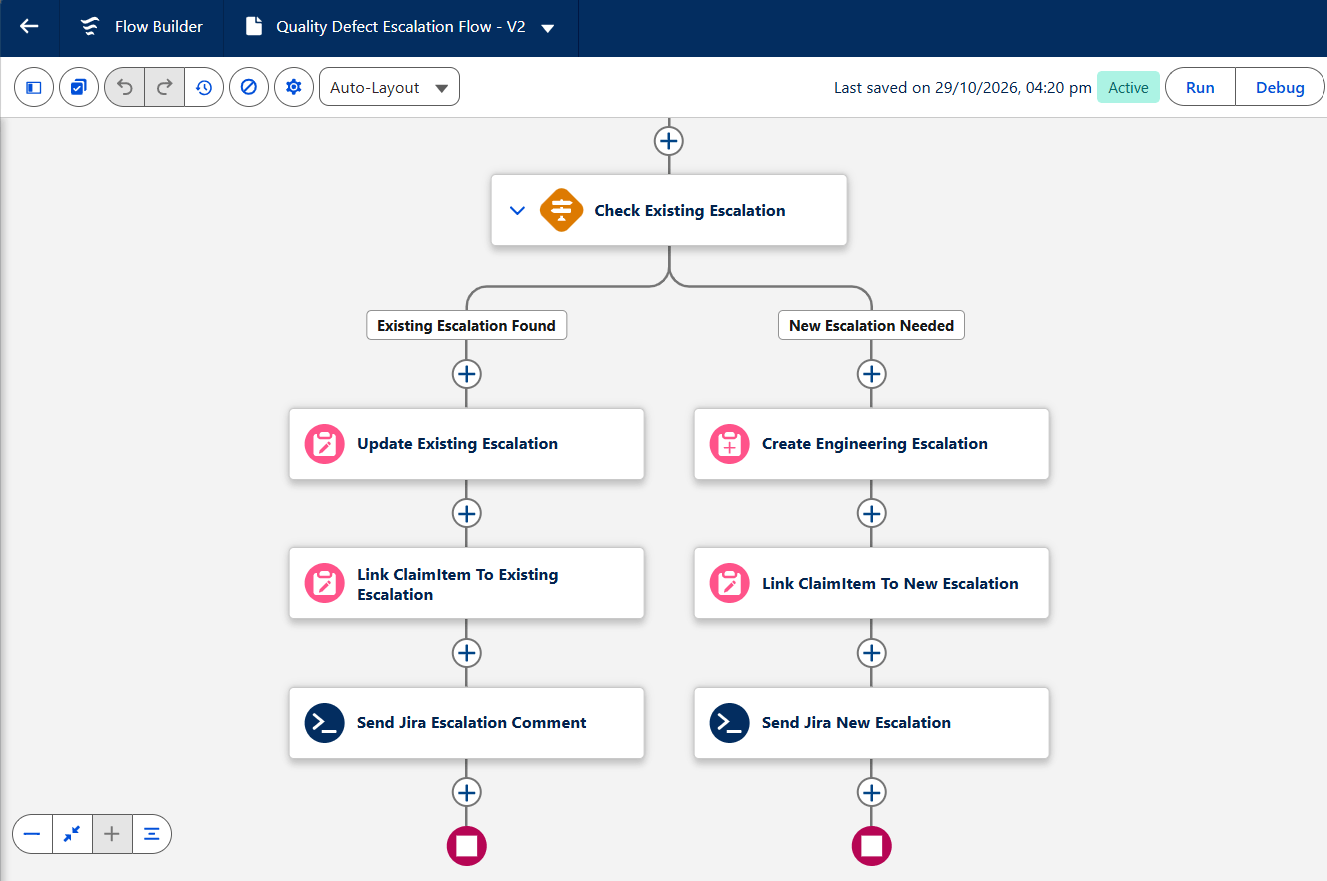
- Implementation approach: The implementation uses explicit logic in a Record-Triggered Flow (Quality_Defect_Escalation_Flow) that queries records where FaultDate >= (TODAY - 60) and calculates:
Step 4: Trigger the engineering escalation
When the defect rate crosses the configured threshold, Salesforce initiates an integration to the organization's engineering system (Atlassian Jira).
The integration uses an asynchronous Queueable Apex callout (JiraEscalationJob) authenticated via Salesforce Named Credentials (callout:Jira_NC) to create an engineering work item containing:
- Affected component and batch identifiers
- Product model and relevant asset references
- Number of qualifying defect events
- Eligible unit count and calculated defect rate
- Observation window and threshold applied
- Related claim identifiers and links
- Diagnostic attachments or secure references to the evidence
The engineering team receives a structured investigation request rather than a generic notification that warranty claims have increased.
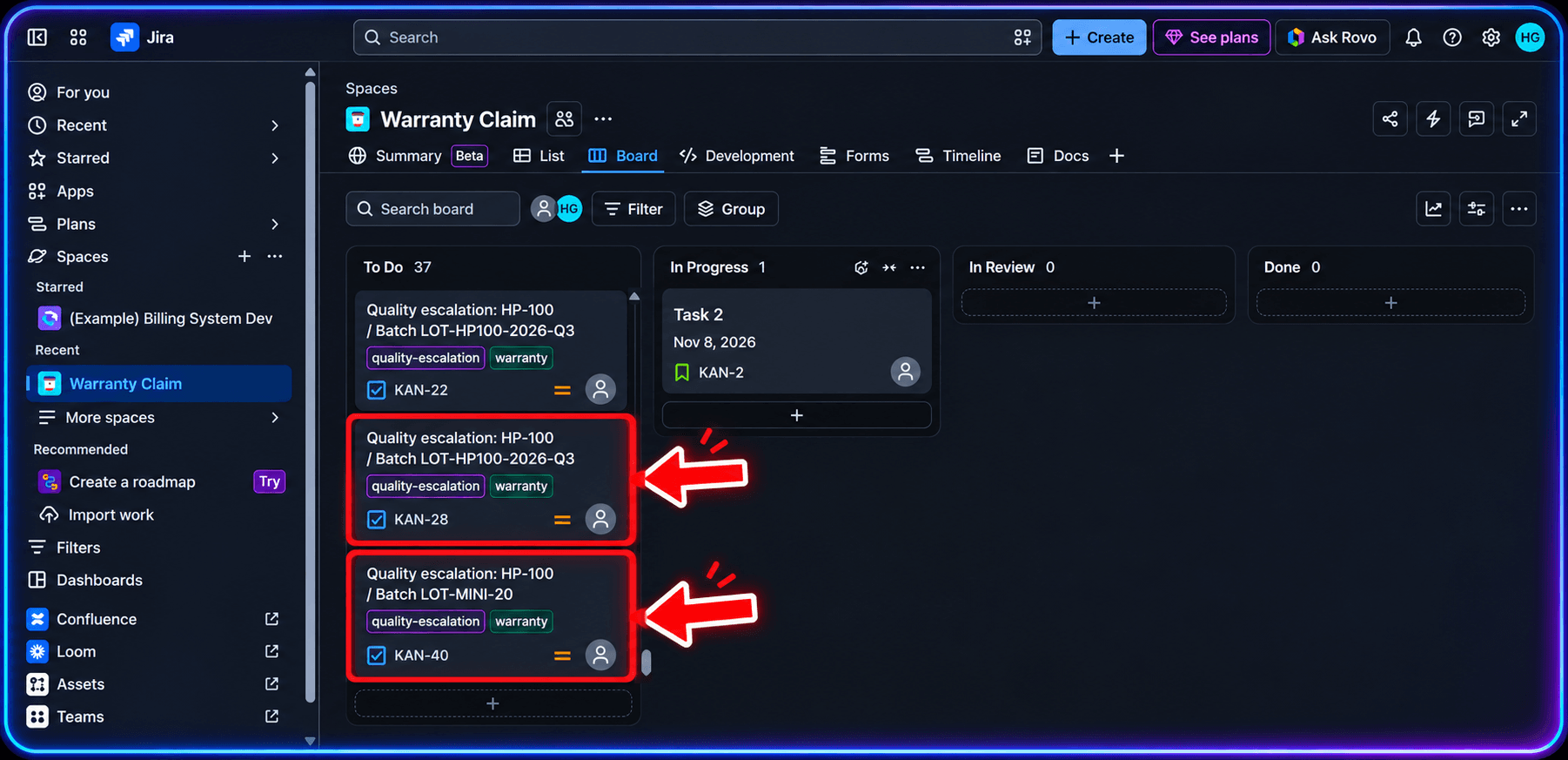
Step 5: Prevent duplicate escalations
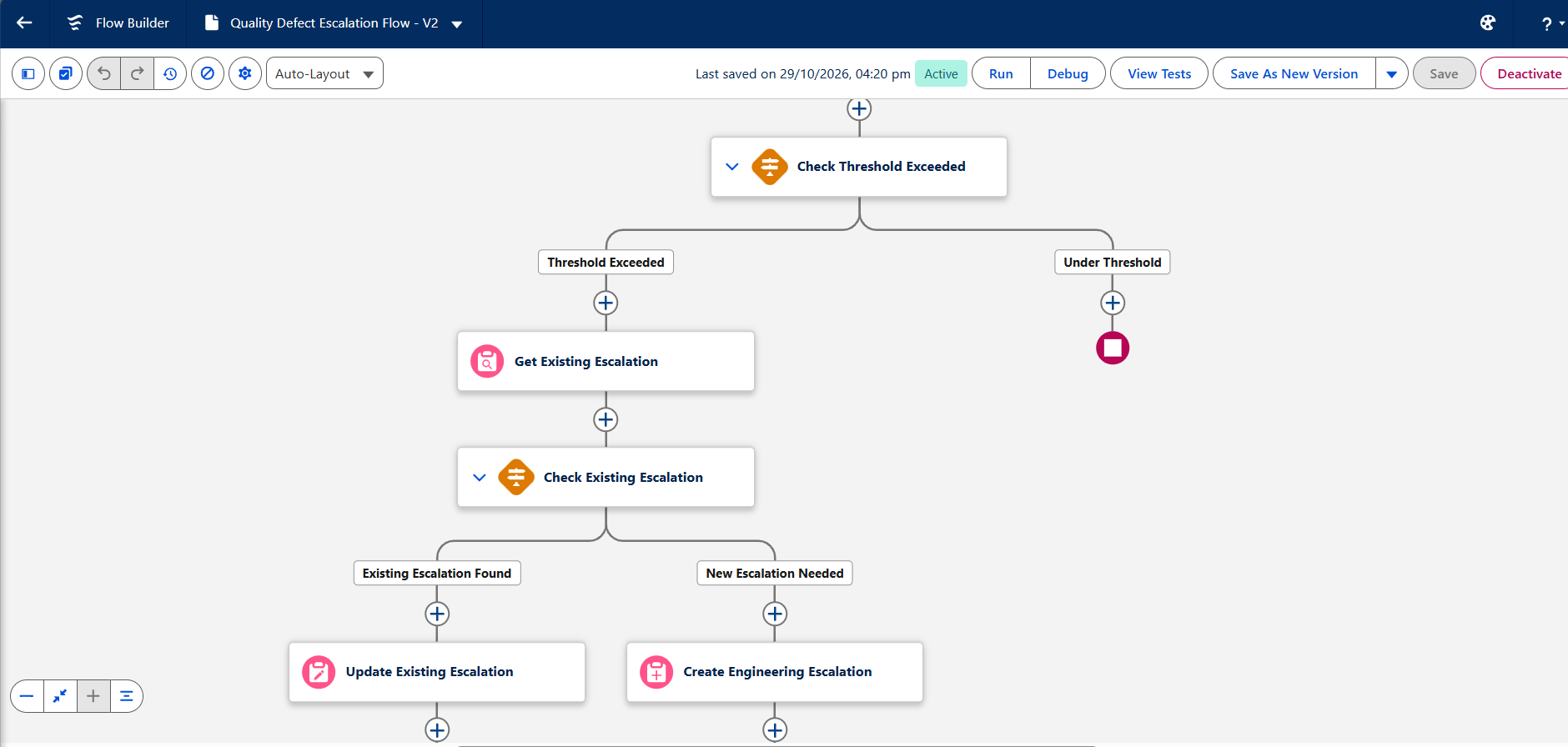
A recurring defect pattern may remain above the threshold for several days or weeks. The system must not create a new engineering ticket every time another Claim Item is processed.
- Persistent Escalation Record: A persistent Engineering_Escalation__c record tracks the ongoing investigation for that component and batch, storing the bidirectional Jira ticket key (Jira_Issue_Key__c).
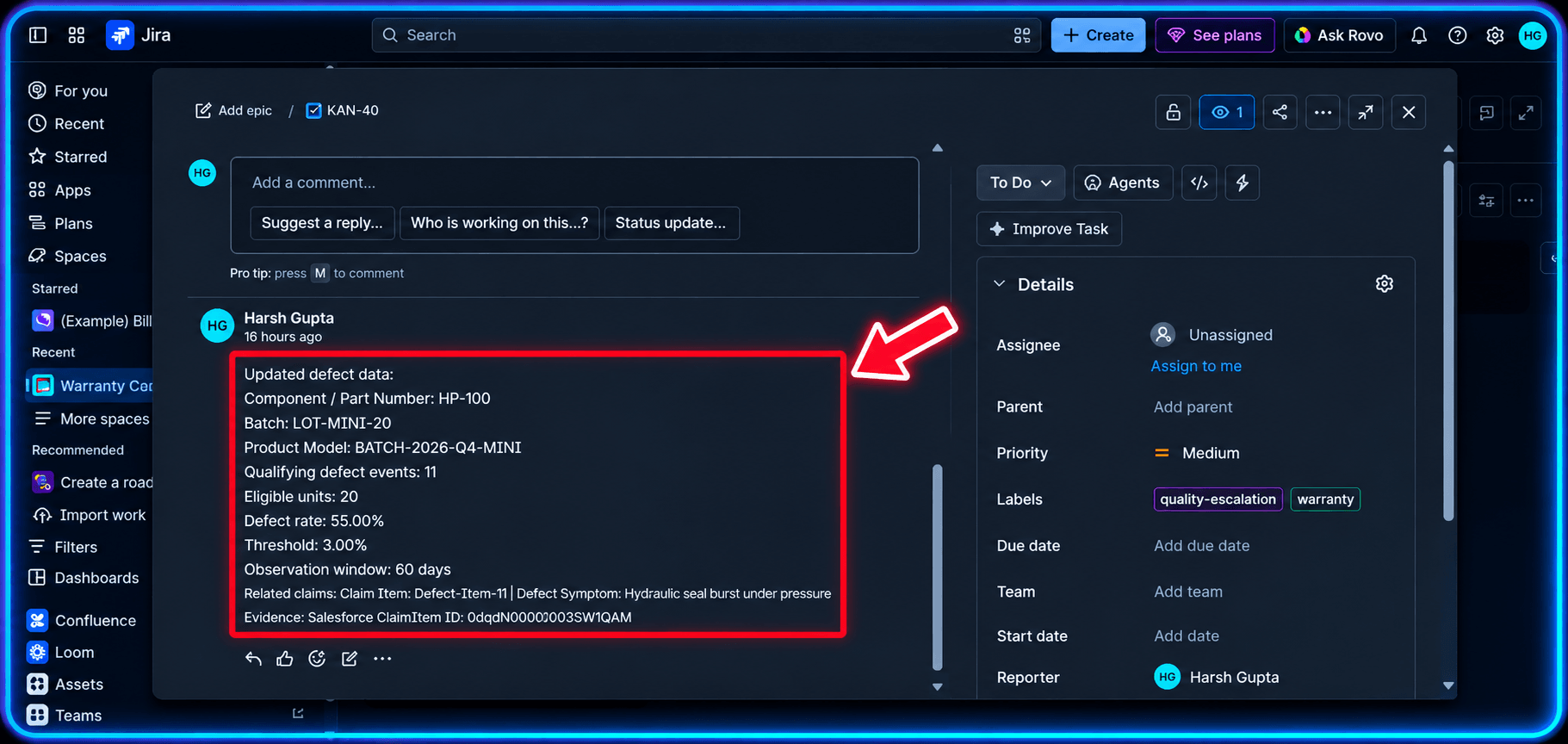
- Subsequent Claim Updates: When subsequent claims arrive for the same batch, the automation associates them with the existing escalation record and executes a Jira comment update (POST /rest/api/2/issue/{key}/comment) rather than generating duplicate tickets.
- Bulk Transaction De-Duplication: To handle high-volume bulk imports (e.g., hundreds of claims loaded simultaneously via API or batch), in-memory transaction deduplication consolidates requests by batch ID, ensuring exactly one Jira ticket is initialized regardless of batch insert size.
6. Where Data Cloud Fits into the Architecture
Salesforce Data Cloud can contribute to the broader solution when the manufacturer needs to combine warranty information with data from other systems.
For example, relevant information may reside in:
- Manufacturing execution systems
- ERP and production databases
- IoT platforms and equipment telemetry
- Distributor portals
- Service and warranty applications
Data Cloud can help unify and analyze data from these sources, depending on the available connectors, data model, ingestion latency, and implementation design.
However, Data Cloud should not automatically be treated as the transactional trigger engine for every Claim Item.
For a straightforward Salesforce-native workflow, a record-triggered Flow may be the more appropriate starting point. Data Cloud becomes particularly useful when defect detection requires a broader view across large datasets or multiple enterprise systems.
A practical architecture may therefore use Salesforce Flow for claim-event handling, a dedicated aggregation mechanism for the rolling defect calculation, and Data Cloud for cross-system analysis where needed.
This separation helps ensure that each component has a clearly defined responsibility.
7. Reliability, Scalability, and Operational Controls
An automated quality feedback loop must be reliable enough to support real engineering decisions.
Several implementation controls deserve particular attention:
- Idempotency: Reprocessing the same Claim Item must not increment defect counts multiple times or create duplicate engineering tickets.
- Recalculation: Changes to claim status, defect classification, component identifiers, or claim dates may require the affected aggregation to be recalculated.
- Rolling-Window Maintenance: Defect events must stop contributing to the 60-day metric once they fall outside the observation window.
- Threshold Crossing: The system should distinguish between the first crossing of a threshold (which creates an issue) and subsequent updates to an existing investigation (which appends comments/metrics).
- Integration Failures: Failed ticket creation or attachment transfers should be logged and retried through a controlled mechanism (e.g., Queueable retry loops up to MAX_ATTEMPTS = 3).
- Auditability: The manufacturer should be able to determine why an escalation occurred, which claims contributed to the calculation, and what threshold was applied.
- Volume Management: High-volume implementations may need asynchronous processing, batching, or Apex-based aggregation instead of performing expensive recalculations synchronously for every Claim Item.
These controls help transform a promising automation concept into a maintainable production solution.
8. Expected Business Benefits
Once implemented and validated, this enhancement can help manufacturers improve the connection between service operations and product engineering.
Potential benefits include:
- Earlier Defect Detection: Identify emerging patterns before they become apparent through periodic reports.
- Lower Investigation Delays: Automatically route relevant evidence directly to engineering in Jira.
- Better Traceability: Connect quality investigations to assets, components, production batches, and warranty claims.
- Reduced Manual Analysis: Minimize spreadsheet-based correlation and repetitive reporting.
- Improved Warranty Cost Visibility: Understand which components or batches are contributing disproportionately to warranty activity.
- Stronger Cross-Functional Collaboration: Give service, warranty, quality, and engineering teams a shared view of recurring issues.
The actual impact will depend on data quality, claim volume, defect classification, integration reliability, and the speed with which engineering teams investigate escalations.
9. Conclusion: Closing the Loop Between Customer Service and Product Engineering
Warranty claims contain valuable information about how products perform in real-world conditions. When that information remains confined to service operations, manufacturers lose an opportunity to detect and investigate recurring quality issues earlier.
An asset-centric quality feedback loop can connect Salesforce Manufacturing Cloud for Service with engineering systems, using configurable defect thresholds, rolling-window calculations, and automated escalations.
The result is a more connected operating model in which warranty activity can become an actionable engineering signal. The broader opportunity is to move from processing individual warranty claims to continuously learning from product failures and using those insights to improve product quality.