Every insurance renewal starts with the same problem: the customer simply does not act on the reminder.
A plain SMS with a shortened link looks like spam. An email gets buried. And even if the customer does click, they land on a portal that asks for a login, vehicle details and several checkout screens. Most of them give up halfway.
At Astrea IT Services, we built a different journey. The customer gets a rich, branded message in their phone's default messaging app, compares plans, pays and gets the renewed policy, all without leaving the chat. In this blog, we walk through how it works and how it is built on Salesforce with Vonage.
The Problem with Traditional Renewals
- Low trust. Plain SMS is limited to 160 characters and unfamiliar links, so customers treat it as phishing.
- Too many steps. Portal login, re-entering vehicle data and multiple checkout screens cause drop-off at every stage.
- Dead-end support. If a customer has a question about add-ons like Zero Depreciation, the SMS cannot help. They have to call a number or abandon the renewal.
- No visibility. Agents in the CRM cannot see whether the customer opened or engaged with the reminder.
The Idea
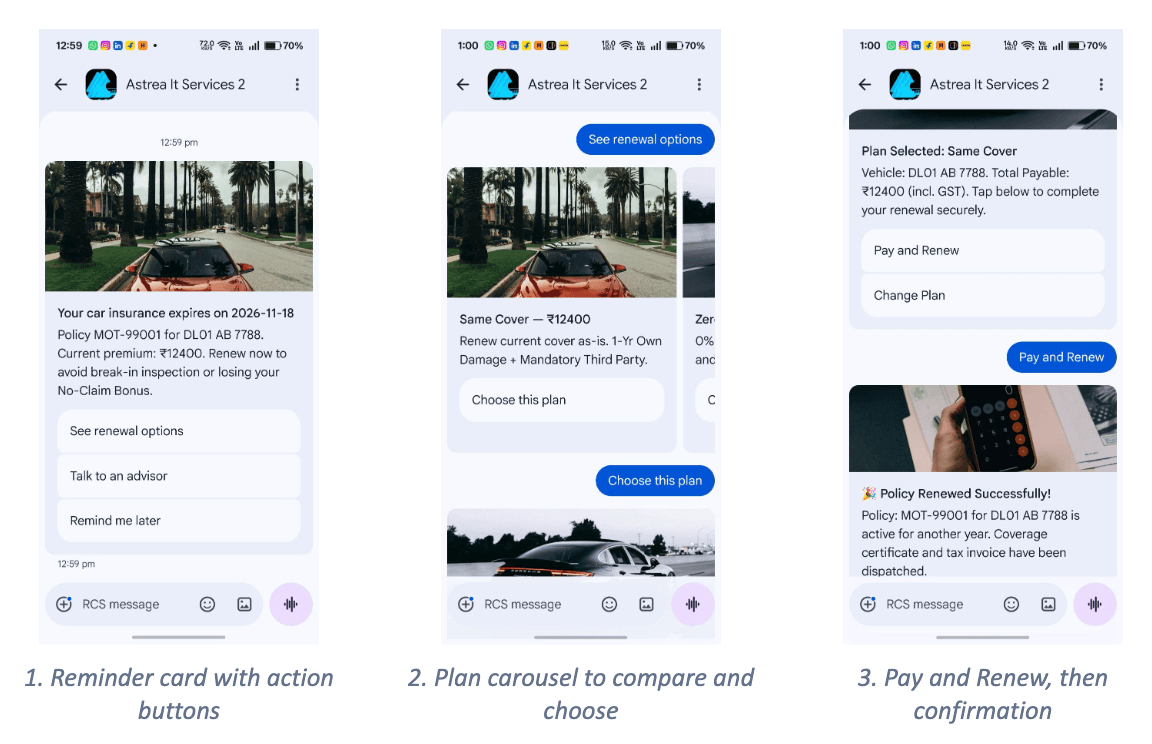
We use RCS (Rich Communication Services), the modern successor to SMS, delivered through the Vonage RCS Business Messaging API. The message arrives in Google Messages from a verified sender with our logo and banner. It shows the vehicle, policy number, expiry date and premium, followed by three buttons: See renewal options, Talk to an advisor and Remind me later.
No app to install, no login to remember. Everything happens in the conversation.
How the Journey Works
- A reminder goes out from Salesforce. Policy records already live in Salesforce. The reminder is sent 15, 7 or 1 day before expiry, with the vehicle, policy number and current premium pre-filled.
- The customer taps See renewal options. A carousel of three plans appears right in the chat: Same Cover at ₹12,400, Zero-Depreciation at ₹14,880 and Comprehensive Plus at ₹17,112, which adds engine protection and 24x7 roadside assistance.
- The customer chooses a plan. One tap on Choose this plan returns a summary card with the selected plan, vehicle number and total payable amount including GST.
- The customer taps Pay and Renew. A secure, pre-filled checkout is generated instantly, with no portal and no re-entering of details.
- The policy is renewed and confirmed. As soon as payment is done, the customer gets a Policy Renewed Successfully card, and the coverage certificate and tax invoice are dispatched.
Human Help When It Is Needed
Not every customer wants to self-serve. If someone taps Talk to an advisor, Salesforce instantly creates a high-priority Task for the policy owner, with the customer's phone number and vehicle details. The customer receives an in-chat confirmation that an advisor will call within 15 minutes.
If they tap Remind me later, the reminder date is pushed back by three days automatically, so the renewal is not lost.
What the Agent Sees in Salesforce
Agents do not have to guess what happened. Each Policy record has a Send RCS Reminder button that opens the Vonage RCS panel. From there an agent can send the reminder, the plans carousel or the payment card, and see the current renewal stage.
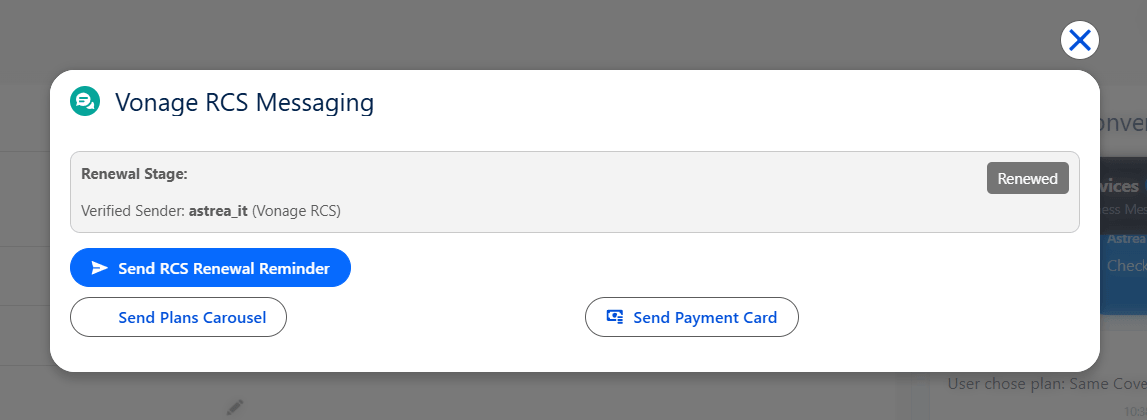
The Vonage RCS panel on the policy record, with the renewal stage and send options
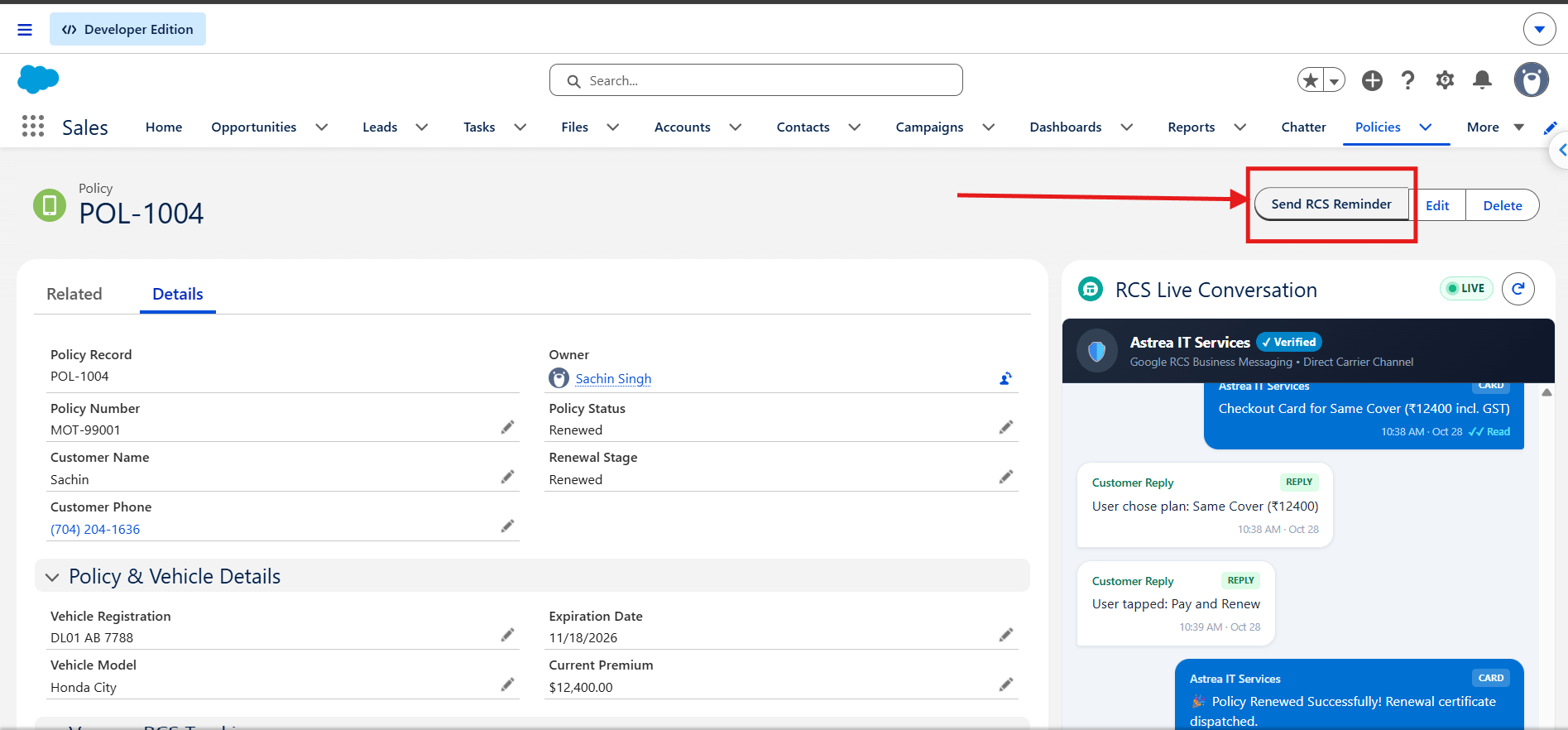
The policy record in Salesforce with the RCS Live Conversation feed. The status moves to Renewed once the customer pays.
Why RCS Instead of SMS or Email
- It looks trustworthy. A verified business badge, logo and banner remove the phishing doubt.
- It is one tap. Buttons and carousels replace links, so fewer steps lead to more completed renewals.
- It is two-way. Questions, plan choices and payments all happen in the same thread.
- It is trackable. Every action is recorded against the policy in Salesforce.
In our comparison with the traditional SMS flow, we expect a big jump in engagement. Open rates move from roughly 20% to above 85%, click-through from 2 to 3% to around 30%, and renewal conversion from 12 to 15% to 25 to 30%. Support requests that took 24 to 48 hours are routed to an advisor in under 15 minutes.
Under the Hood
For the technically curious, the solution is built from a few simple parts.
- Salesforce holds the Policy and RCS Message objects. Apex classes send the cards and process customer replies, and a Lightning Web Component powers the live chat feed.
- Vonage RCS Business Messaging API delivers the messages to Google Messages and returns delivery receipts. Requests are authenticated with short-lived RSA-256 signed JWTs.
- A Cloudflare Worker sits in front of Salesforce as a webhook relay. Vonage rejects mid-connection TLS renegotiation, which Salesforce Sites requests, so replies never arrived. The Worker terminates TLS cleanly, answers Vonage immediately and forwards the payload to Salesforce in the background.
- Queueable Apex jobs make sure outbound calls are completed before any database changes are saved, which avoids the uncommitted work pending error.
Conclusion
A renewal works best when it feels like a conversation, not a form. By combining Salesforce as the system of record, Vonage for RCS delivery and a lightweight edge relay for reliability, we turned a reminder that people ignored into a one-tap experience that is tracked end to end.
The same pattern can be extended to claims, policy changes and payment receipts.
Want Something Similar?
If you want to reach your customers with rich, trackable messages directly from your CRM, we would be glad to help.