Imagine a company where the Sales team reports 12,500 active customers, Marketing reports 12,150, and Finance arrives at a completely different number. Everyone is working with the same business data, yet every report tells a different story.
The problem usually isn't the data itself—it's the lack of a structured approach to processing it. Different teams apply different transformations, business rules get duplicated, and over time, the platform becomes difficult to maintain.
This is where the Medallion Architecture comes in.
Instead of trying to clean and transform data immediately after ingestion, the Medallion Architecture improves data progressively through multiple layers. Each layer has a well-defined responsibility, making pipelines easier to build, maintain, and scale while ensuring that downstream users always work with trusted data.
What is the Medallion Architecture?
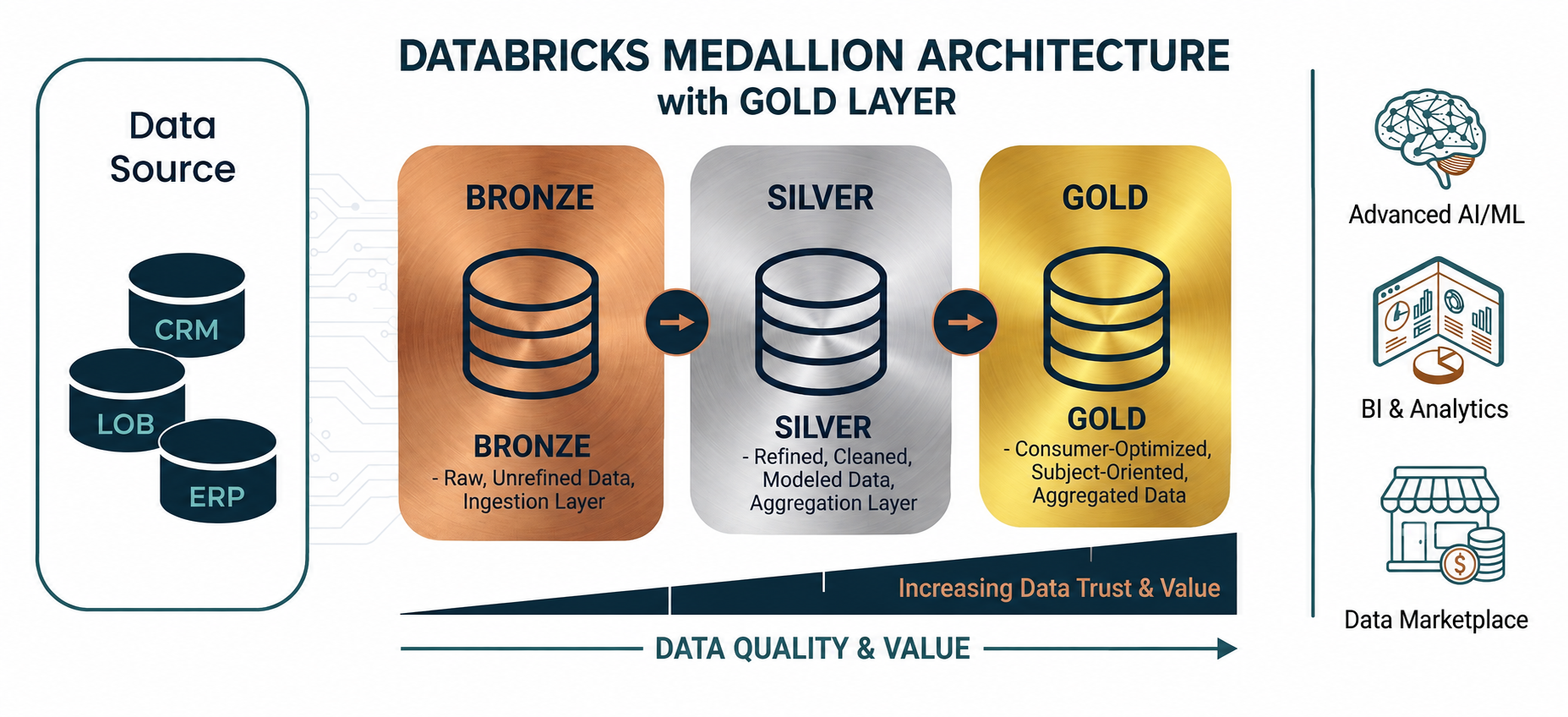
The Medallion Architecture is a layered data design pattern widely adopted in modern lakehouse platforms such as Databricks. It organizes data into multiple stages, where each stage increases the quality and business value of the data.
The traditional architecture consists of three layers:
- Bronze – Raw data collected from source systems
- Silver – Cleaned, validated, and standardized data
- Gold – Business-ready data optimized for analytics and reporting
By separating data into these layers, organizations can gradually improve data quality instead of attempting to perform every transformation during ingestion.
Bronze Layer Example :
Bronze Layer – Preserving Raw Data
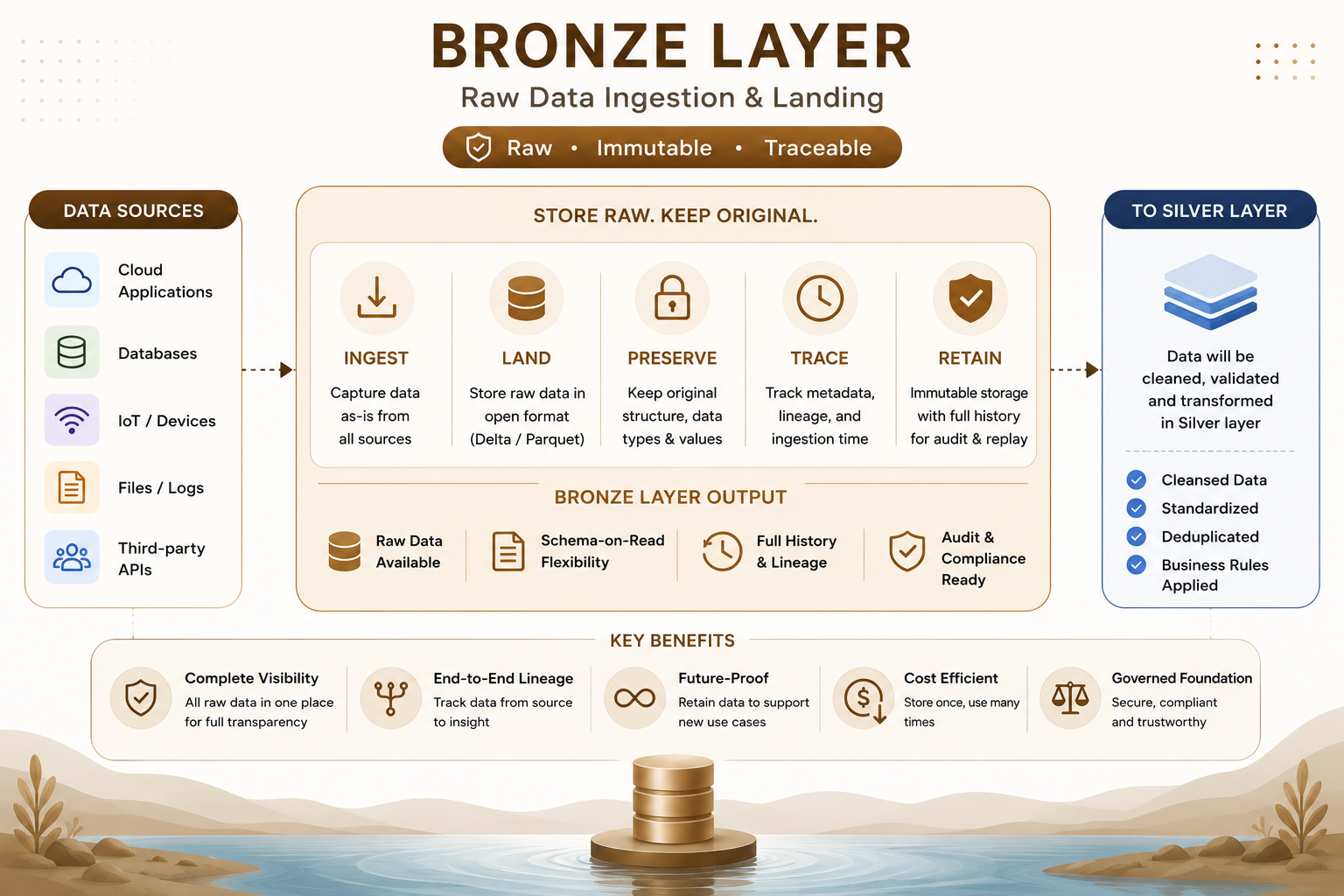
The Bronze layer is the foundation of the Medallion Architecture and acts as the landing zone for all incoming data.
Its primary objective is simple:
Store the data exactly as it arrives from the source.
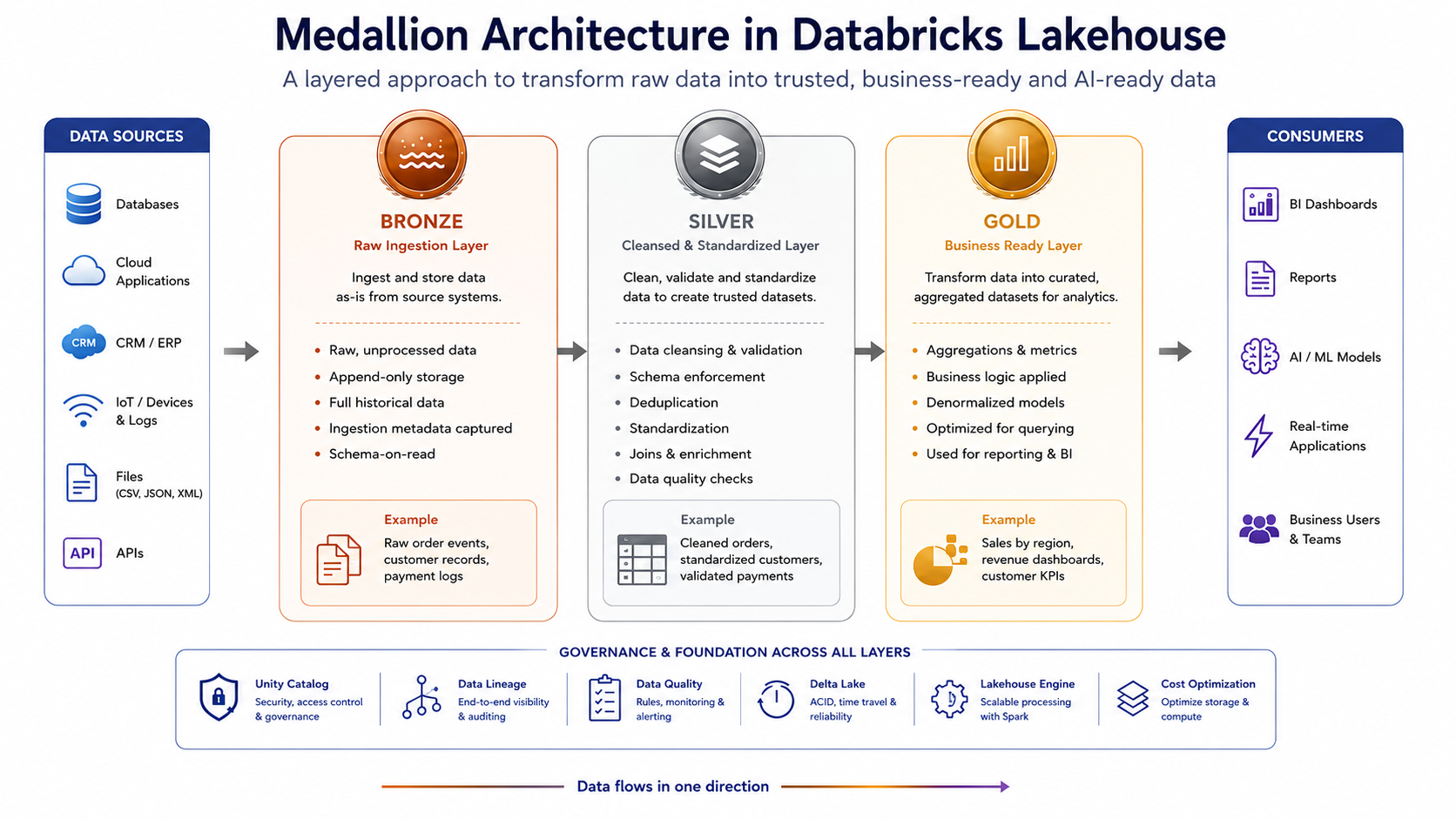
At this stage, minimal transformations are performed. Raw records are preserved to maintain a complete historical copy of the source data.
Typical data sources include:
- Databases
- Salesforce and other CRM systems
- ERP applications
- REST APIs
- CSV or JSON files
- IoT devices
- Event streaming platforms
Since the Bronze layer serves as the system of record, it allows data engineers to reprocess historical data whenever business rules change or downstream pipelines fail.
Typical characteristics of the Bronze layer include:
- Raw, unmodified data
- Append-only processing
- Historical data preservation
- Ingestion metadata such as load timestamps and source information
- Minimal validation
The Bronze layer is not intended for reporting or analytics. Instead, it provides a reliable foundation for all downstream processing.
Bronze Layer example :
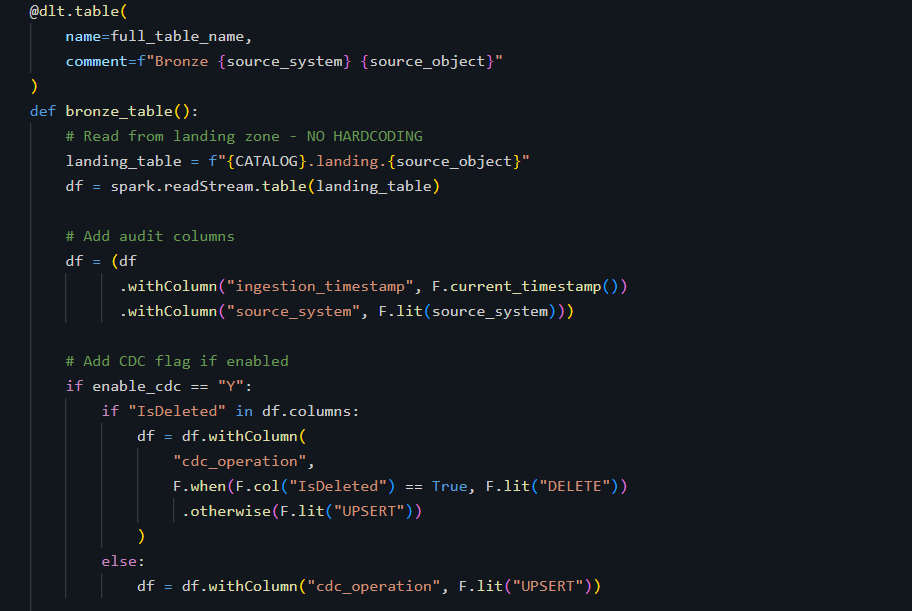
In this step, we ingest raw Salesforce object data from the Landing Zone into the Bronze layer using a Delta Live Tables (DLT) streaming pipeline. The pipeline dynamically reads the configured Salesforce object, adds audit information such as ingestion timestamp and source system, and identifies the type of CDC operation (UPSERT or DELETE). The Bronze layer preserves the raw data in its original form, creating a reliable foundation for downstream processing.
Silver Layer – Cleaning and Standardizing Data
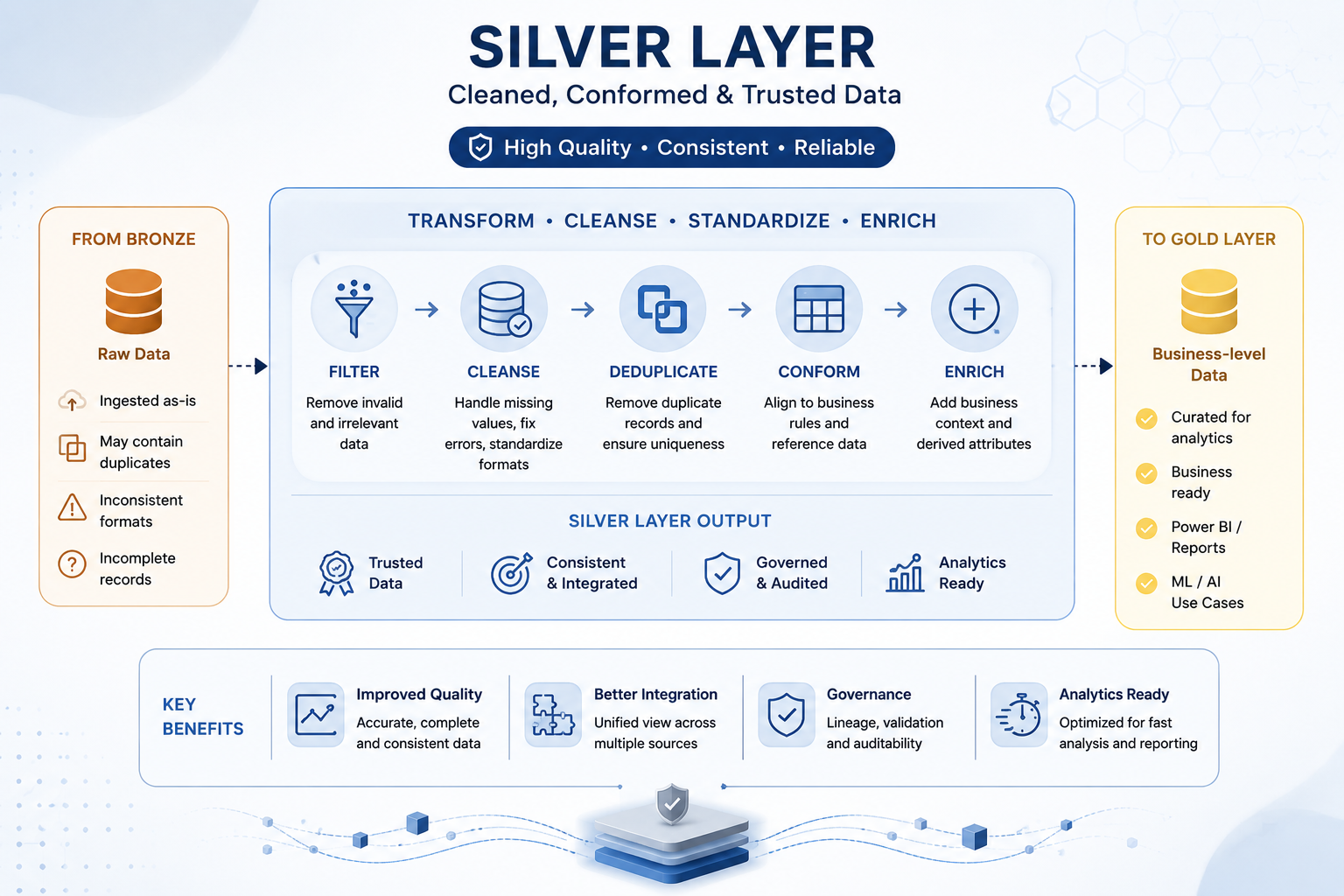
Once raw data has been safely stored, it moves into the Silver layer where it is transformed into a trusted and consistent format.
This is where most of the data engineering work happens.
Common transformations include:
- Removing duplicate records
- Handling missing values
- Standardizing date and timestamp formats
- Applying schema validation
- Joining related datasets
- Filtering invalid records
- Performing data quality checks
For example, imagine an e-commerce platform where the same customer appears multiple times with slightly different information. The Silver layer identifies duplicate records, standardizes customer information, validates order data, and creates a consistent representation of each customer.
Unlike the Bronze layer, which prioritizes data preservation, the Silver layer focuses on producing reliable datasets that can safely be used for downstream analytics.
Many organizations also implement Change Data Capture (CDC) and automated data quality checks at this stage to ensure only trusted data progresses through the pipeline.
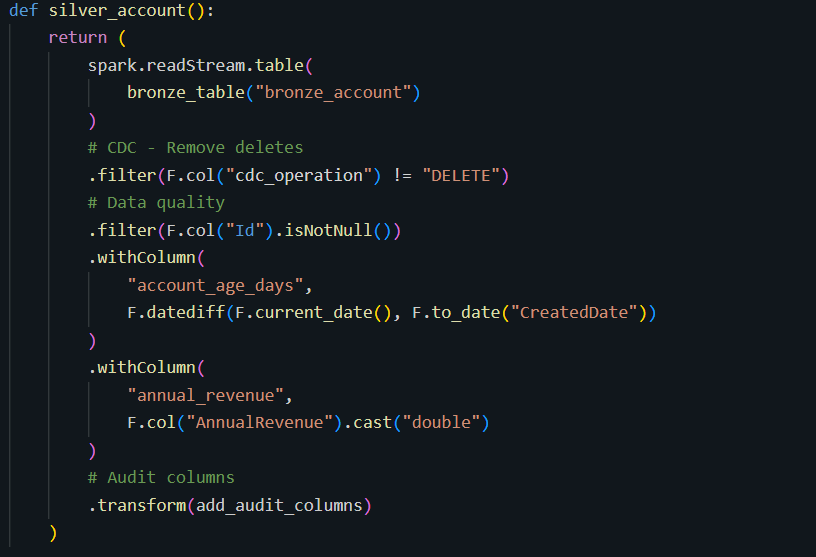
Silver Layer example :
In this step, the pipeline reads Account data from the Bronze layer and applies data quality and transformation rules to create a trusted dataset. Deleted records are filtered out using CDC metadata, mandatory fields are validated, business-friendly columns such as account age and annual revenue are derived, and audit metadata is added. The resulting Silver table contains clean, standardized, and analysis-ready data for downstream business processing.
Gold Layer – Business-Ready Data
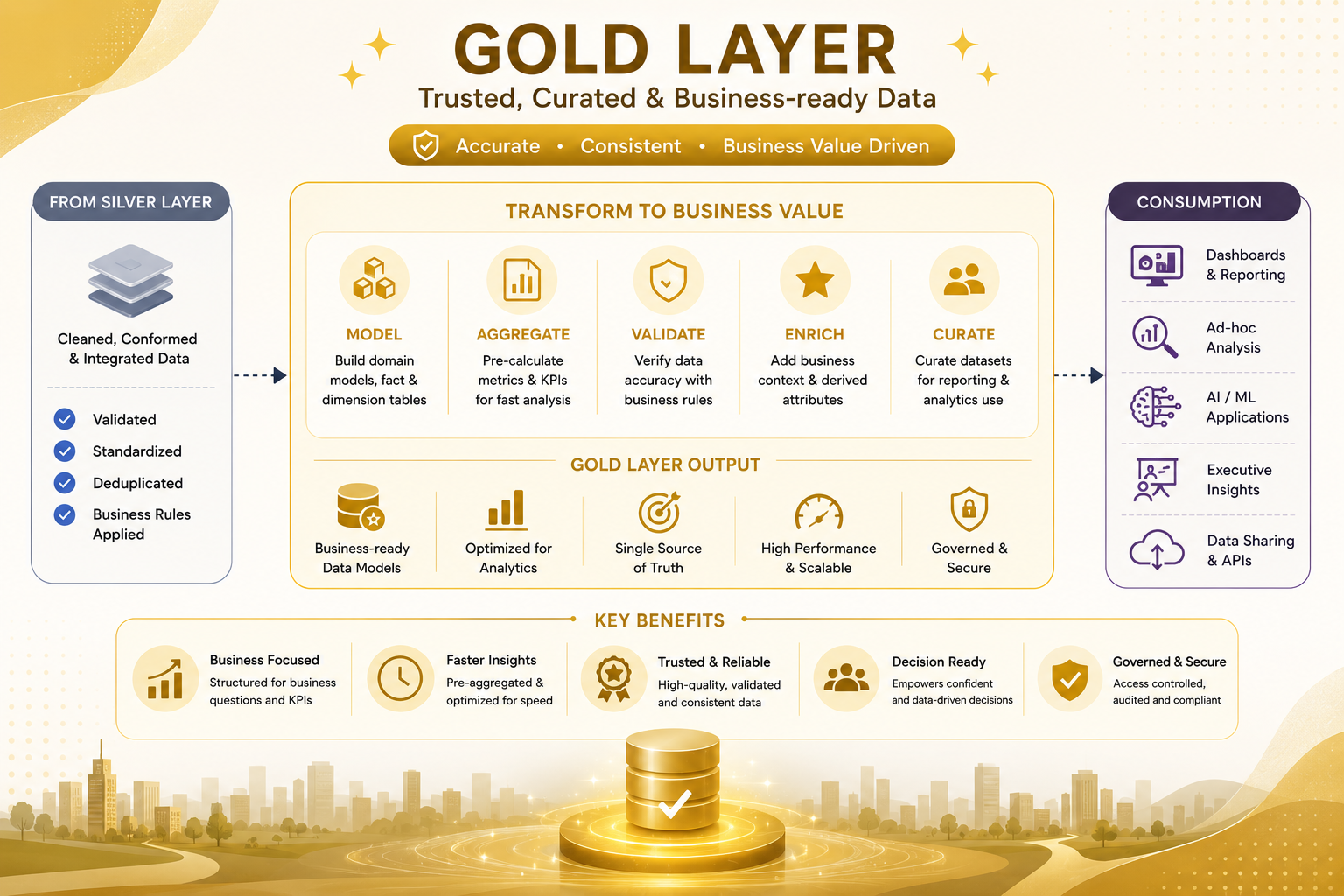
The Gold layer represents the final stage of the traditional Medallion Architecture.
Here, clean data is transformed into business-friendly datasets optimized for reporting, dashboards, and analytical workloads.
Instead of working with raw transactions, users interact with curated datasets such as:
- Daily sales summaries
- Customer lifetime value
- Product performance metrics
- Financial reports
- Operational dashboards
- Department-specific KPIs
The Gold layer stores clean, business-ready data that can be easily used for dashboards and reports.
Because business logic has already been applied, analysts and business users can focus on generating insights rather than preparing data.
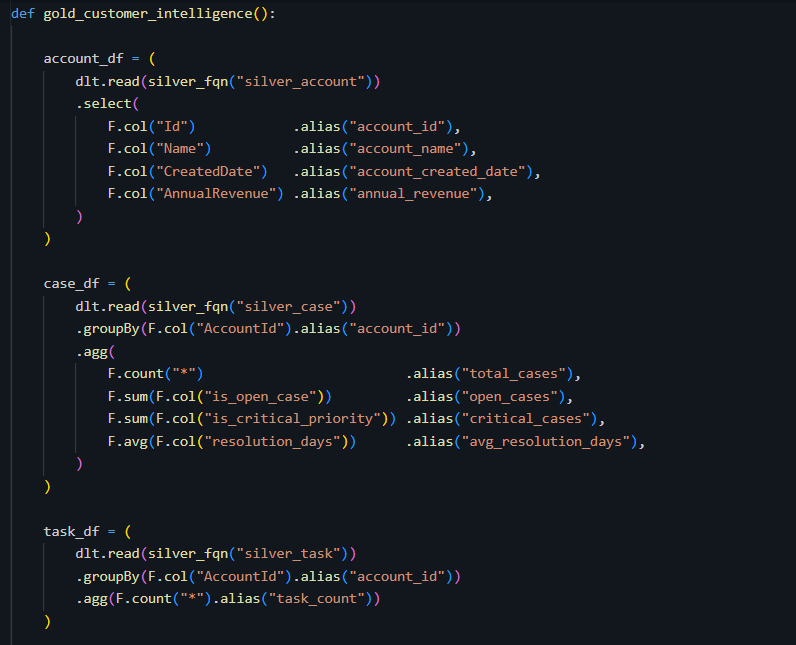
Gold Layer example :
In this step, the pipeline reads refined data from multiple Silver tables, including Accounts, Cases, and Tasks, and combines them to create a customer intelligence dataset. Business metrics such as total cases, open cases, critical cases, average resolution time, and task count are calculated for each account. The resulting Gold table provides a consolidated, business-ready view that can be directly used for dashboards, reporting, and business analytics.
Proposed Platinum Layer for Advanced Analytics
Note: As of now, Databricks has not announced a public release date for a dedicated Platinum Layer in its Medallion Architecture, and it is not part of the official Databricks product roadmap. The Platinum Layer discussed in this article represents a conceptual extension adopted by some organizations to support AI/ML workloads, data products, and advanced analytics beyond the Gold layer.
For many organizations, the Gold layer is sufficient.
However, modern data platforms increasingly power AI models, recommendation engines, fraud detection systems, real-time personalization, and operational applications. These workloads often require datasets that go beyond traditional reporting.
This is where some organizations introduce an optional Platinum layer.
Unlike the Gold layer, which is optimized for business analytics, the proposed Platinum layer is designed to deliver highly refined, governed, and AI-ready datasets that support real-time feature access, advanced data enrichment, semantic entity resolution, and operational intelligence for production AI/ML applications.
Rather than replacing the Gold layer, Platinum builds upon it to support advanced use cases that demand greater consistency, richer context, and stricter governance.
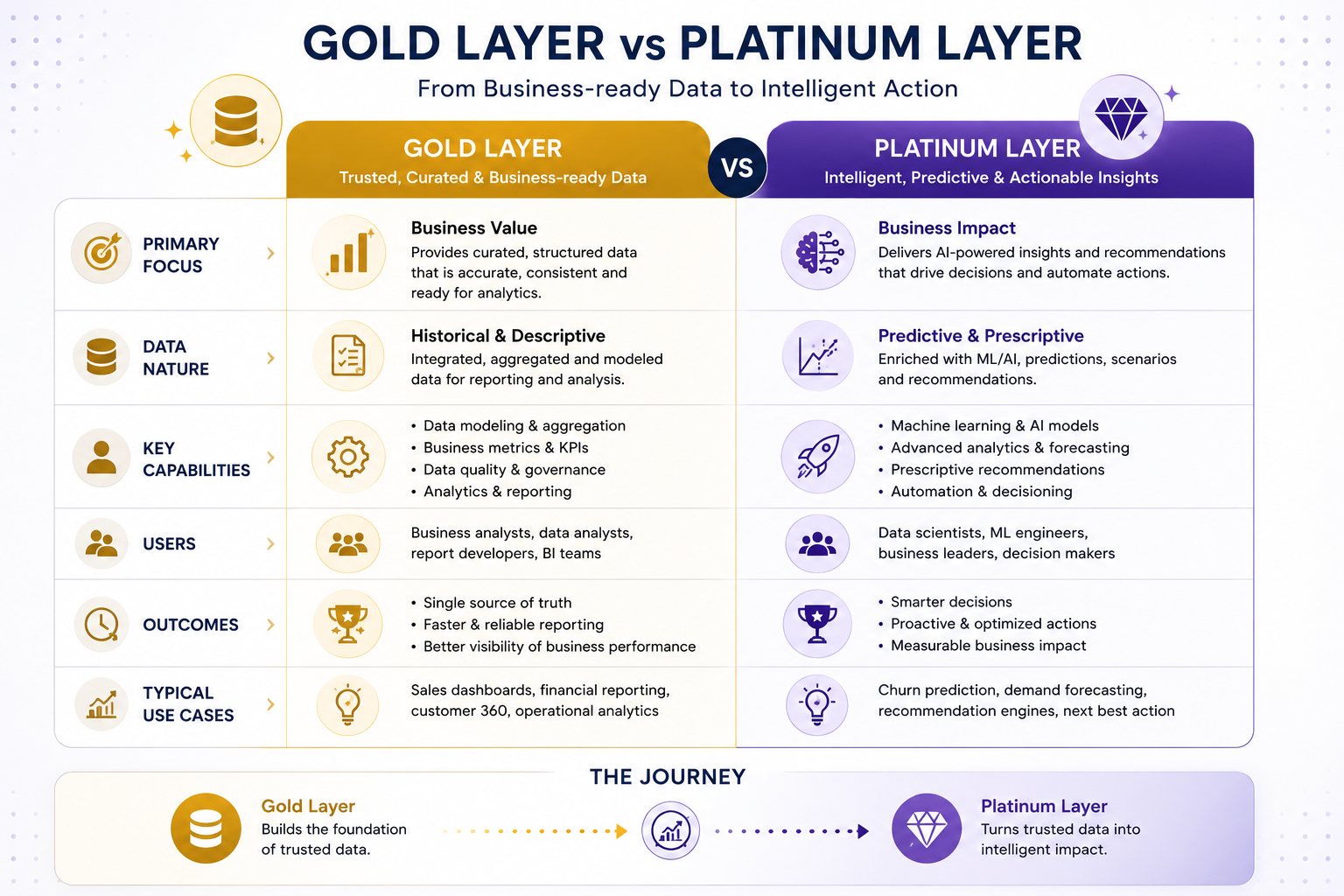
The Platinum layer transforms business-ready datasets into reliable data products that can be safely consumed by AI models, machine learning pipelines, and operational systems.
Typical Responsibilities of the Proposed Platinum Layer
- Feature-Ready Datasets: Create reusable features that can be shared across multiple machine learning models, reducing duplicate feature engineering efforts.
- Cross-Domain Data Enrichment: Combine data from multiple business domains (such as customers, products, sales, and marketing) to create a unified, AI-ready dataset.
- Semantic Data Quality: Validate business rules, detect anomalies, identify missing critical information, and monitor data quality beyond technical validation.
- Stable Data Products: Provide governed datasets with controlled schemas, versioning, lineage, ownership, and SLAs to ensure reliable consumption by production applications.
- AI/ML Optimization: Deliver highly refined, governed datasets optimized for production AI, machine learning, and real-time intelligent applications.
Databricks Services That Support the Medallion Architecture
The Medallion Architecture is a design pattern rather than a specific Databricks feature. However, Databricks provides several services that simplify its implementation.
Some commonly used components include:
- Delta Lake for reliable storage, ACID transactions, and time travel.
- Lakeflow Declarative Pipelines for building automated ingestion and transformation pipelines.
- Unity Catalog for centralized governance, security, and data lineage.
- Change Data Capture (CDC) or efficient incremental processing.
- MLflow for managing the machine learning lifecycle.
- Feature Engineering / Feature Store for creating reusable ML features.
- Model Serving for deploying trained models into production.
Together, these services enable organizations to build scalable, secure, and AI-ready data platforms.
Best Practices
When implementing the Medallion Architecture, consider the following best practices:
- Preserve raw data in the Bronze layer without applying business logic.
- Perform cleansing, validation, and standardization in the Silver layer.
- Build business-friendly datasets in the Gold layer instead of directly from Bronze.
- Introduce a Platinum layer only when advanced AI, ML, or operational workloads require it.
- Treat Platinum datasets as governed data products rather than additional reporting tables.
- Use centralized governance with Unity Catalog to manage security and lineage.
- Continuously monitor data quality throughout the pipeline.
Conclusion
The Medallion Architecture provides a simple yet effective framework for organizing data as it progresses from raw ingestion to business-ready insights.The Bronze layer preserves raw data, the Silver layer improves quality and consistency, and the Gold layer delivers trusted datasets for reporting and analytics. By adopting a structured approach to data refinement, teams can reduce complexity, improve data quality, and build a stronger foundation for analytics, machine learning, and intelligent applications.
If you're interested in exploring more Databricks solutions, visit our Databricks page.
For any queries please reach out to support@astreait.com