Unifying the Customer Journey: A Salesforce Data Cloud Implementation for a Leading Automotive Manufacturer
Executive Summary
Our client is a leading global automobile manufacturer with a multi-model portfolio sold and serviced through a large dealer network. Like most automotive OEMs, customer data was scattered across CRM, dealer management systems, websites, mobile apps, service centers, and paid media platforms - making it difficult to see a single customer across the pre-sales, sales, aftersales, and digital journey.
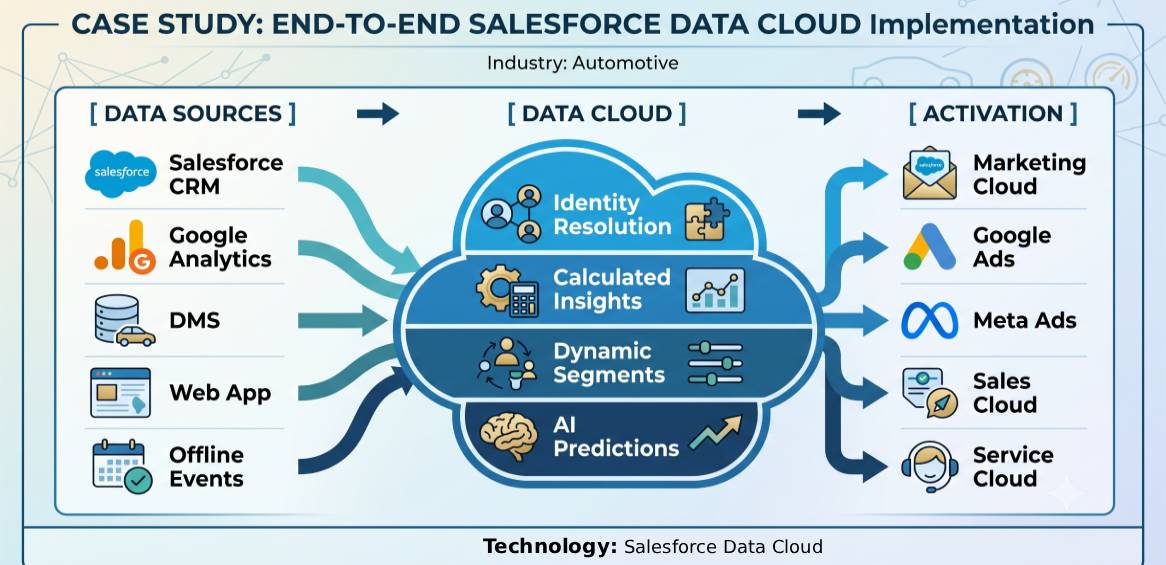
We designed and implemented an end-to-end Salesforce Data Cloud architecture that ingests data from all these sources, models and unifies it into a single customer profile, layers in calculated insights, and powers over 20 dynamic segments activated directly into Marketing Cloud Engagement, Google Ads, and Meta Ads. This case study walks through that architecture stage by stage - from raw data ingestion through to activation.

Figure 1: End-to-end Data Cloud architecture flow implemented for the client, detailed stage by stage below.
Client Overview
The client is a multi-brand automotive manufacturer with a global dealer and service network, offering a broad portfolio of passenger and commercial vehicles. The business engages customers across the full lifecycle - from initial research and test drives, through purchase, to ongoing servicing, repurchase, and connected digital services.
Business Challenge
Prior to the Data Cloud implementation, the client faced common data fragmentation challenges typical of large automotive organizations:
- Customer and vehicle data siloed across CRM, Dealer Management Systems (DMS), website, mobile app, service centers, and campaign tools.
- No single, unified view of a customer spanning pre-sales interest, purchase history, service history, and digital engagement.
- Manual, spreadsheet-driven segmentation that was slow to build and quickly went stale.
- Delayed or inconsistent activation of audiences across email, SMS, and paid media, leading to generic rather than personalized outreach.
- Limited ability to proactively identify aftersales churn risk or repurchase readiness at the individual customer level.
End-to-End Architecture
The sections below walk through each stage of the architecture in the order data actually flows - from raw source systems to activated, personalized customer segments.
Stage 1: Data Sources
Data originates from systems spanning the full customer lifecycle:
- Salesforce CRM - leads, opportunities, customer and vehicle records, service cases.
- Google Analytics (via BigQuery) - website and app behavior: vehicle configurator usage, page visits, form starts/completions.
- Campaign and engagement platforms - email, SMS, and paid media engagement history.
Stage 2: Ingestion - Ingestion API & Data Streams
Each source connects into Data Cloud using the ingestion method best suited to it:
- Ingestion API - used for Salesforce CRM data. Structured customer, lead, vehicle, and transaction records are pushed into Data Cloud on a scheduled or event-driven basis, landing as Data Lake Objects (DLOs).
- Direct Data Streams - used for digital engagement data. Google Analytics data is streamed via BigQuery, capturing near real-time website and app behavior without custom ETL.
Every source, once connected, is configured as a Data Stream in Data Cloud, with a defined refresh cadence and a mapped Data Lake Object as its landing zone.
Stage 3: Data Model Objects (DMOs) & Relationships
Data Lake Objects are mapped to Data Model Objects (DMOs) - Salesforce's standardized, queryable schema. Both standard DMOs (Individual, Contact Point Email, Contact Point Phone) and custom DMOs (Vehicle, Dealership, Service History, Lead, Campaign Engagement) were configured for this implementation.
Relationships were then defined between DMOs so the platform understands how entities connect - for example, linking an Individual to every Vehicle they own, every Service History record tied to that vehicle, every Lead they generated, and every Campaign Engagement event they triggered. These relationships are what make cross-functional segmentation (e.g. combining a pre-sales signal with an aftersales status) possible.
Stage 4: Identity Resolution & Unification
With DMOs and relationships in place, Identity Resolution rulesets reconcile records that represent the same person across CRM, GA, and digital sources - matching on email, phone, and other identifiers, with configurable match and reconciliation rules to resolve conflicts (e.g. most-recent-value-wins for updated contact details).
The output is a single Unified Individual profile per customer, bringing together their pre-sales interest, purchase and service history, and digital engagement into one queryable record - the foundation every downstream insight and segment is built on.
Stage 5: Calculated Insights (CI)
On top of the unified profile, Calculated Insights were built across three pillars aligned to the client's business, each combining data from multiple DMOs:
- Pre-Sales Metrics - e.g. lead score, test drive activity, vehicle configurator engagement, etc.
- Aftersales Metrics - e.g. service due date, warranty status, churn risk score, satisfaction indicators.
- Digital Services Metrics - e.g. connected app usage, digital service engagement, retargeting eligibility.
Each Calculated Insight is defined once in Data Cloud and computed automatically on a refresh schedule, so downstream segments always reflect current customer state rather than a point-in-time snapshot.
Stage 6: Segmentation
Calculated Insights and unified profile attributes feed into dynamic, rule-based segments that recompute automatically as underlying data changes - no manual list-building. Over different segments were built spanning pre-sales, aftersales, digital services, campaign orchestration, milestone triggers, and contact-policy governance.
Stage 7: Activation
Segments are published to Data Cloud's Activation layer and connected to downstream platforms through native activation targets:
- Salesforce Marketing Cloud Engagement (MCE) - for email and SMS journeys.
- Google Ads - for search and display audience targeting.
- Meta (Facebook) Ads - for social audience targeting and lookalike modeling.
Because activation is connected directly to the unified, segmented data model, updates to a customer's segment membership propagate to these channels on the segment's refresh schedule, keeping outbound messaging aligned with the customer's current status.
Use Cases & Segments Delivered
Different use-case-driven segments were built and operationalized across the customer lifecycle, spanning pre-sales, aftersales, digital services, campaign orchestration, and governance:
| Category | Use Case / Segment |
|---|---|
| Pre-Sales | Missed Appointment Follow-Up |
| Aftersales | Aftersales Potential Churn Reduction |
| Campaign Ops | Dynamic Campaign Management |
| Aftersales | Encouraging Repurchase |
| Pre-Sales | Test Drive |
| Digital Services | Retargeting Customers |
| Lifecycle | Milestone Trigger |
| Governance | Using Contact Policy |
| Campaign Ops | Orchestrating Campaigns Through Multiple Platforms |
While the focus of this case study is the architecture itself, the design directly supports measurable outcomes across the customer lifecycle - proactive aftersales retention, model-specific repurchase targeting, faster campaign activation, and more relevant, timely customer messaging. Detailed outcome metrics can be added here once finalized with the client.
Technology & Platforms Used
| Layer | Technology |
|---|---|
| Ingestion | Ingestion API (Salesforce CRM); Direct Data Streams via BigQuery (Google Analytics) |
| Modeling | Data Lake Objects (DLO), Data Model Objects (DMO) & relationships |
| Unification | Identity resolution & reconciliation rules |
| Insights | Calculated Insights - pre-sales, aftersales, digital services |
| Segmentation | Data Cloud Segmentation (20+ dynamic segments) |
| Activation | Marketing Cloud Engagement, Google Ads, Meta (Facebook) Ads |
Conclusion
By consolidating fragmented automotive customer data into a single Salesforce Data Cloud foundation, the client moved from manual, disconnected segmentation to an automated, insight-driven engagement engine spanning the full customer lifecycle - from first test drive to long-term ownership and repurchase. The architecture is extensible, allowing new data sources, insights, and activation channels to be added as the business grows.
Need support with a similar project?
Contact Details
- +91-9818348569
- support@astreait.com