Introduction
Marketing today is no longer just about running campaigns — it is about making data-driven decisions. Businesses invest across multiple channels such as television, social media, search ads, and offline campaigns, but understanding the true impact of each channel remains a major challenge.
This project focuses on building a Marketing Mix Modeling (MMM) system that helps analyze how different marketing channels contribute to overall business performance. By using historical data and statistical modeling techniques, the system estimates the impact of each channel on revenue and identifies important patterns such as diminishing returns and saturation.
Live Application link
To make these insights actionable, an interactive dashboard was developed using Shiny. It allows users to analyze channel performance, simulate changes in marketing spend, and understand the impact on revenue through key metrics like ROAS and mROAS. Overall, the system simplifies complex modeling into an intuitive tool for better marketing decisions.
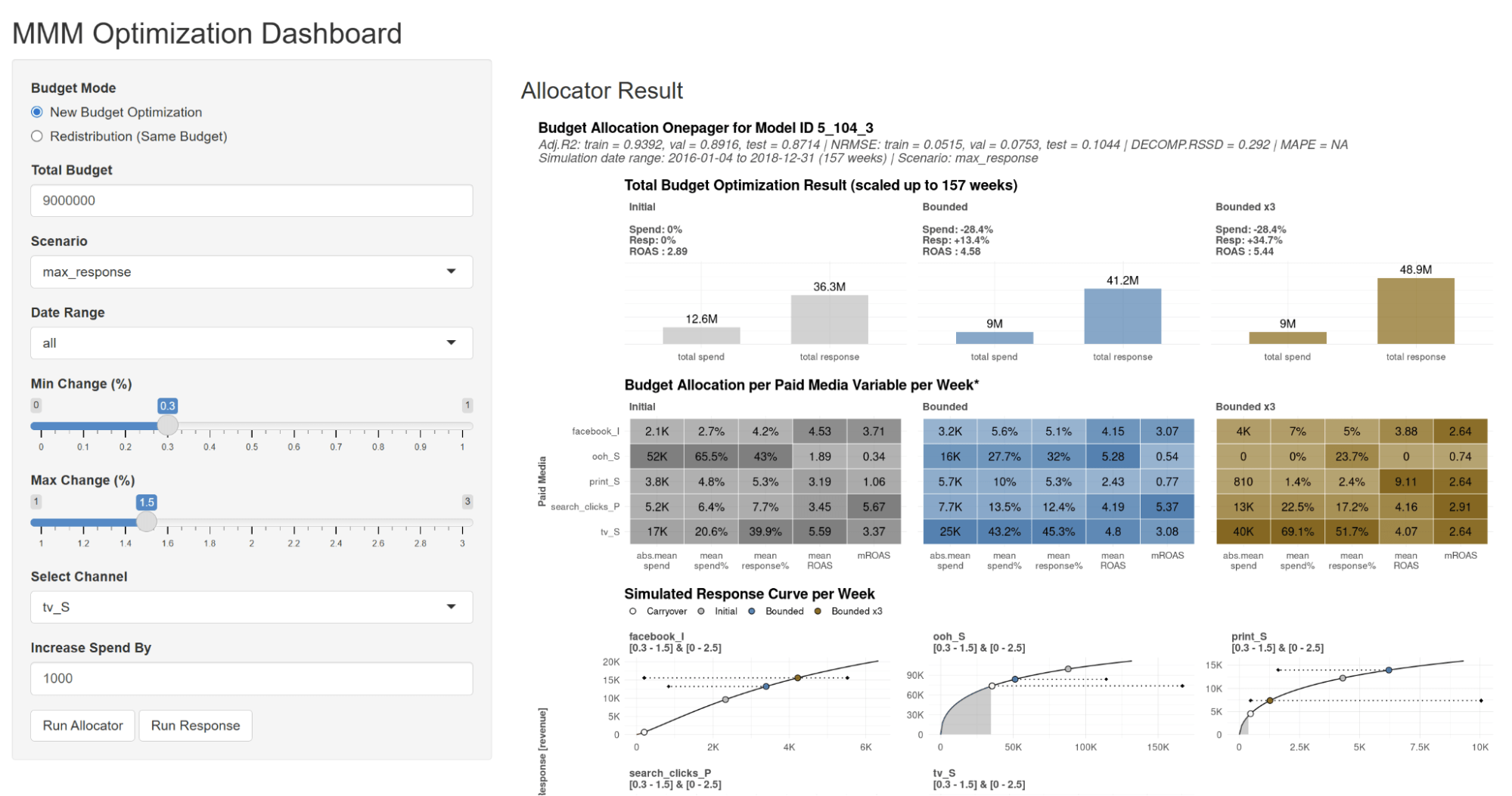
Figure: MMM Optimization Dashboard showing budget allocation and response analysis
Problem Statement
In today’s marketing landscape, businesses invest across multiple channels such as television, social media, and search advertising. However, understanding how each channel contributes to overall revenue remains a challenge.
Decisions are often based on surface-level metrics like clicks or impressions, which do not reflect true business impact. This leads to inefficient budget allocation, where some channels are overfunded while others are underutilized.
Additionally, marketing performance is not linear. As spend increases, returns begin to diminish, making it difficult to identify the optimal level of investment.
These challenges highlight the need for a data-driven approach to measure performance and optimize marketing spend effectively.
Solution Overview
To address challenges in measuring marketing performance and optimizing budget allocation, this project uses Marketing Mix Modeling (MMM) combined with an interactive dashboard.
The model analyzes historical data to understand how different channels contribute to revenue, capturing key effects such as diminishing returns. Built using Robyn and integrated with a Shiny dashboard, the system allows users to explore performance, optimize budget allocation, and simulate the impact of spend changes.
Overall, the solution transforms complex analytics into simple, actionable insights for better marketing decision-making.
Data Overview
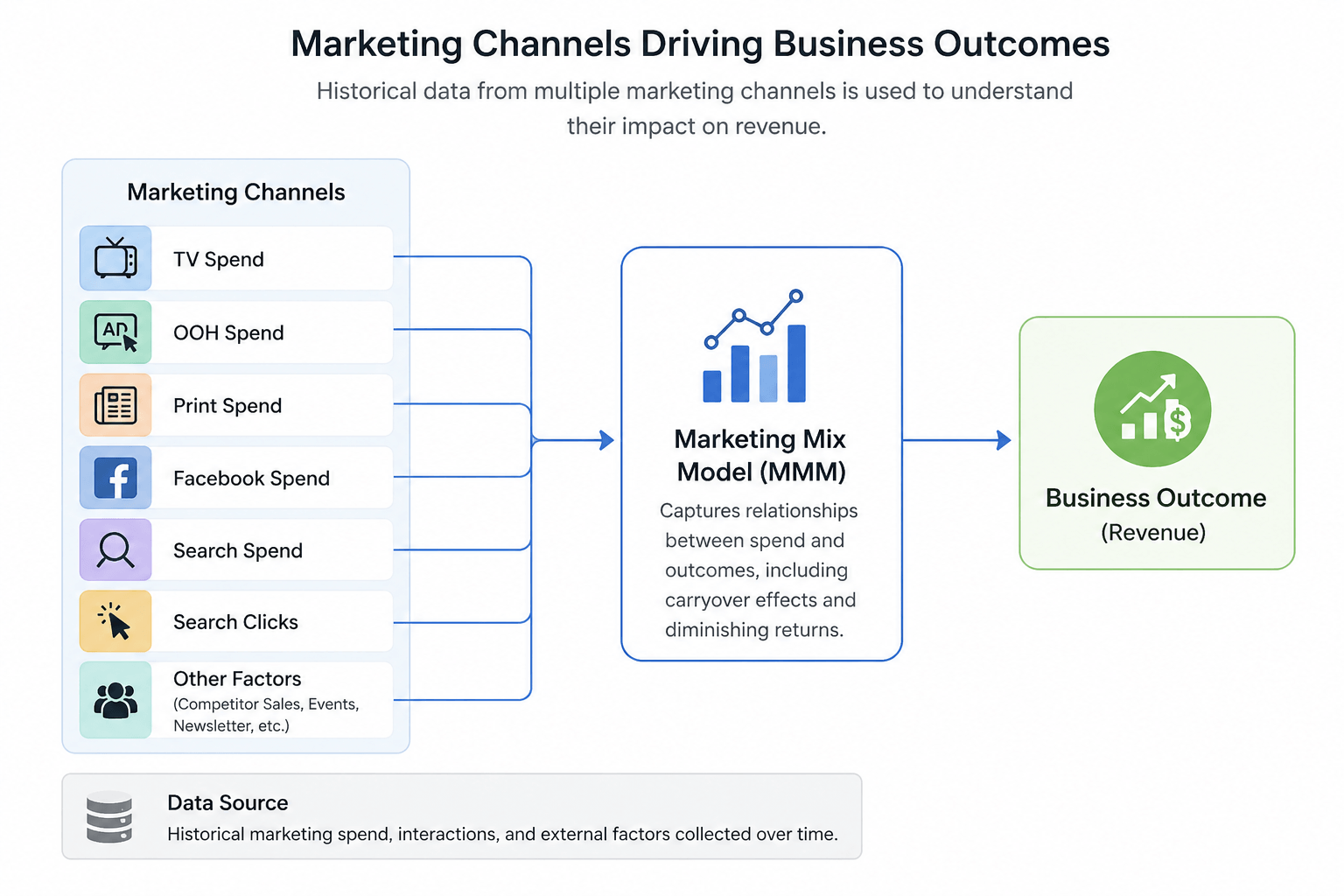
The project uses time-series marketing data collected over multiple periods. Each record represents a specific time interval (weekly in this case) and contains information about marketing activities and corresponding business outcomes.
The dataset includes multiple marketing channels such as television, social media, search advertising, print media, and outdoor campaigns. For each channel, the data captures the amount of spend or activity during that period.
In addition to marketing inputs, the dataset also includes the main business outcome variable, which is revenue. This allows the model to understand how changes in marketing efforts influence overall business performance.
Some additional variables such as competitor activity and external factors are also included to improve the accuracy of the model by accounting for influences beyond marketing.
Overall, the dataset provides a structured view of how marketing inputs and external factors interact over time, enabling the model to learn meaningful relationships between spend and revenue.
Key Concepts
Marketing Mix Modeling (MMM)
Marketing Mix Modeling (MMM) is a statistical technique used to measure the impact of different marketing channels on business outcomes such as revenue. Instead of analyzing channels individually, MMM evaluates the combined effect of all marketing activities while accounting for external factors. This helps in understanding which channels contribute the most and how they influence overall performance.
Response Curve
A response curve shows the relationship between marketing spend and the resulting business outcome. It illustrates how increasing investment in a channel affects revenue.
One important insight from response curves is diminishing returns. As spending increases, the incremental gain in revenue starts to decrease. This helps identify the point where additional spending becomes less effective and prevents over-investment in a channel.
Return on Ad Spend (ROAS)
Return on Ad Spend (ROAS) measures the total return generated for every unit of money spent on marketing. It is calculated as:
ROAS = Revenue / Spend
ROAS helps evaluate the overall efficiency of a marketing channel and indicates whether the investment is profitable.
Marginal ROAS (mROAS)
Marginal ROAS (mROAS) measures the return generated from additional or incremental spending. It focuses on the impact of increasing the budget rather than total performance.
mROAS is especially useful for decision-making because it shows whether increasing spend in a channel will lead to meaningful gains. A high mROAS indicates strong growth potential, while a low mROAS suggests that the channel may be reaching saturation.
System Features
The system provides two main functionalities that help in analyzing marketing performance and making better budget decisions.
Budget Allocation Optimization
This feature optimizes how the total marketing budget is distributed across channels. It considers channel effectiveness and diminishing returns to recommend an allocation that maximizes overall performance. This helps businesses reallocate spend more efficiently and improve results without increasing total budget.
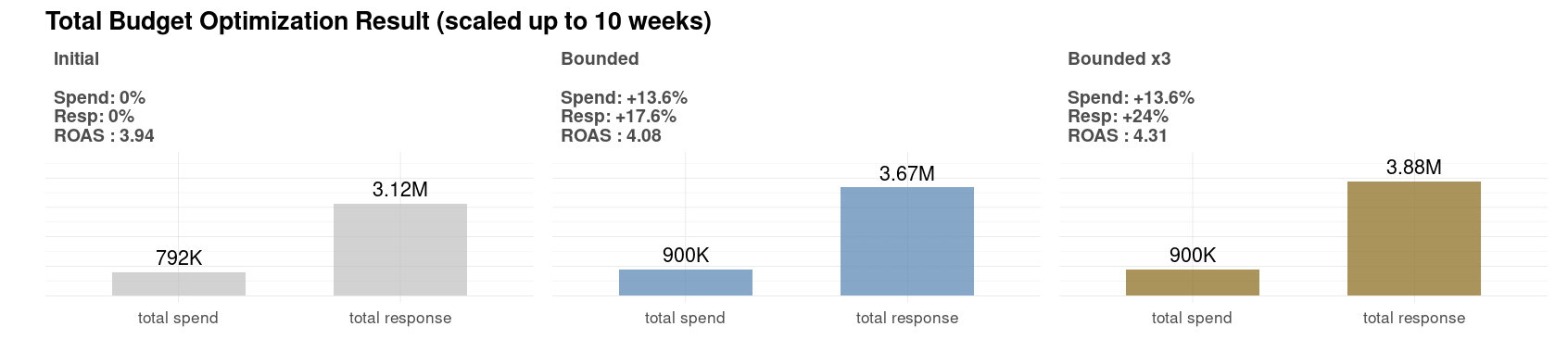
Figure: Optimized budget allocation showing improvement in spend efficiency and total response
Response Simulation
This feature allows users to simulate changes in spend for a specific channel and observe the resulting impact on revenue. It helps evaluate the incremental value of additional investment and identify whether a channel has growth potential or is reaching saturation.
The system also provides key metrics such as ROAS and mROAS, helping evaluate overall efficiency and the impact of additional spend for better decision-making.
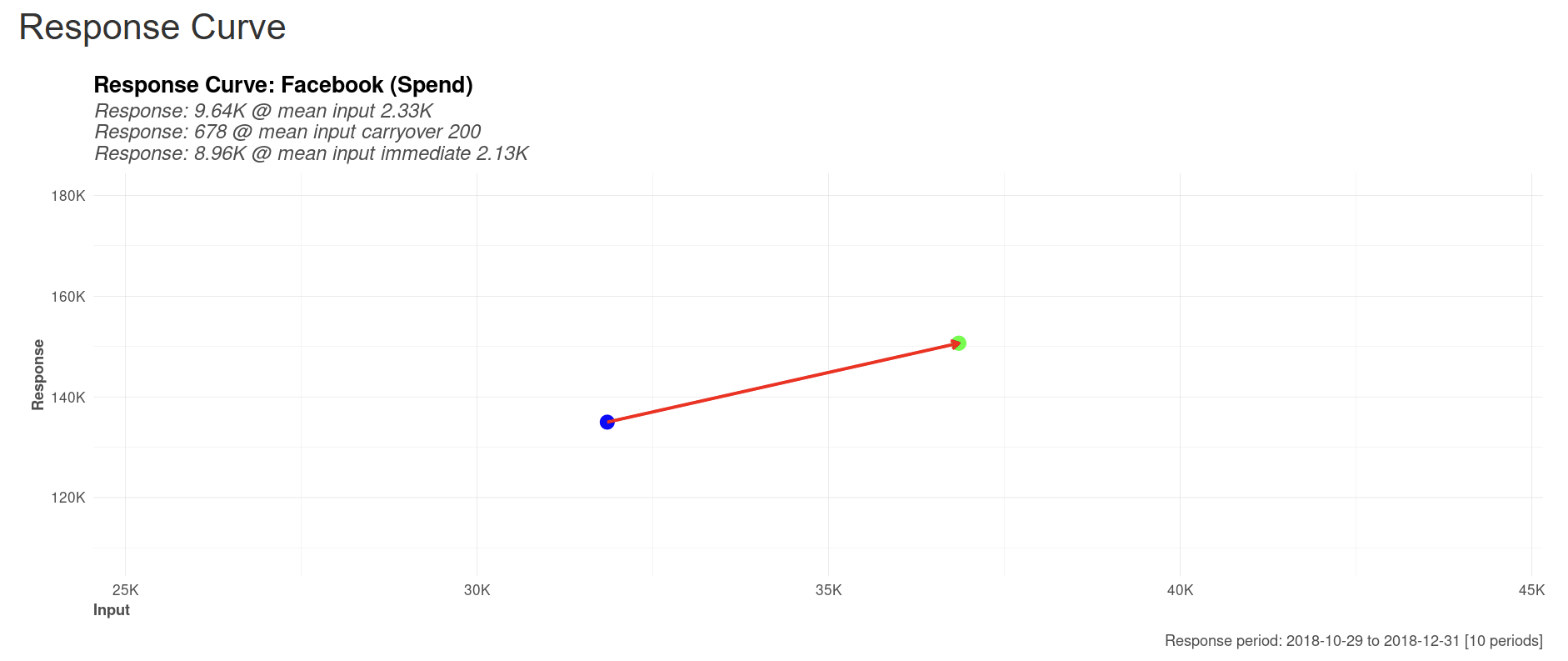
Figure: Response curve showing the impact of increasing spend on expected response, highlighting incremental gains
Increasing spend on Facebook leads to higher response, but the slope indicates diminishing returns, meaning each additional unit of spend generates smaller incremental gains.
Workflow
The system is designed to be simple and intuitive, allowing users to interact with the model through a structured workflow. The process begins with selecting the desired inputs and ends with actionable insights.
First, the user selects the overall scenario and inputs the total budget. Based on these inputs, the system runs the budget allocation model to distribute the budget across different channels in an optimal way.
Once the allocation is generated, the user can analyze how the budget has been distributed and compare it with the previous allocation. This helps in identifying which channels are recommended for increased or reduced investment.
Next, the user selects a specific channel and uses the response simulation feature to test different spending scenarios. By adjusting the spend amount, the system shows how the response changes and provides the incremental impact.
Finally, the system calculates key performance metrics such as ROAS and mROAS and generates insights based on the results. These insights help users understand whether to increase, maintain, or reduce spending in a particular channel.
Overall, the workflow enables users to move from data input to actionable decision-making in a clear and structured manner.
Key Insights and Interpretation
The system generates actionable insights that help improve marketing decision-making.
It identifies high- and low-performing channels using ROAS and mROAS, allowing businesses to focus on channels that deliver better returns.
Response curves highlight saturation effects, showing when additional spend leads to diminishing returns and helping avoid over-investment.
The system also evaluates incremental impact, making it easier to understand whether increasing spend will generate meaningful gains.
Additionally, the allocator reveals opportunities to reallocate budget from less efficient channels to higher-performing ones, improving overall performance without increasing total spend.
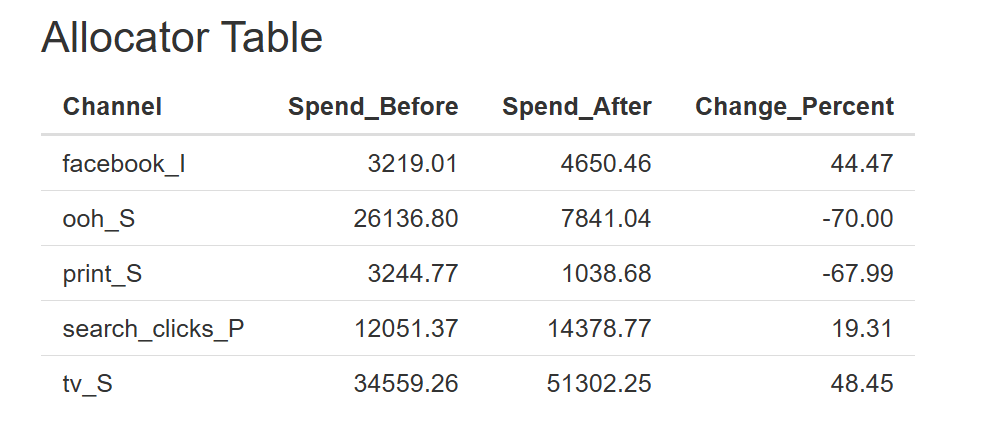
Figure: Budget reallocation highlighting high-performing and low-performing channels
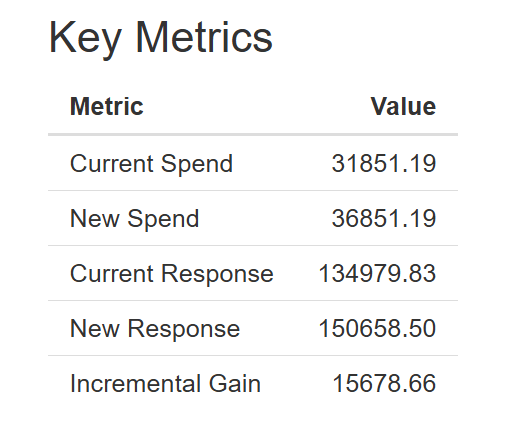
Figure: Change in spend and corresponding impact on response
Business Value
The system enables data-driven marketing decisions by helping businesses allocate budgets more effectively across channels.
It improves return on investment by identifying high-performing channels and reducing spend on less efficient ones.
The model also prevents wasted spending by detecting saturation points, ensuring that additional investment generates meaningful returns.
With scenario simulation, businesses can test different strategies before investing, reducing risk and improving decision confidence.
Overall, the system enhances transparency and helps optimize marketing performance for better outcomes.
Limitations
The model’s accuracy depends on the quality and completeness of input data, so inconsistent data can affect results.
Since it is based on historical data, it assumes past patterns will continue, which may not always hold true in changing market conditions.
Additionally, not all external factors or qualitative aspects of marketing, such as brand perception, can be fully captured.
Despite these limitations, the system provides a strong foundation for data-driven marketing decisions when used appropriately.
Future Improvements
The system can be further enhanced by integrating real-time data to enable more dynamic decision-making.
Future versions could also support advanced optimization objectives, such as balancing growth and efficiency.
Improving the user interface with better visualizations and interactivity would enhance usability.
Additionally, extending the model to more granular levels, such as campaign or region-wise analysis, could provide deeper insights.
Integration with other business tools like CRM or marketing platforms would further improve practical usability.
Deployment
The system has been deployed as a web application using Shiny, which allows users to access the dashboard through a web browser without requiring any local setup.
The application is hosted on the shinyapps.io platform, making it easily accessible and scalable. Users can interact with the dashboard, run simulations, and analyze results in real time from any device with internet access.
The deployment ensures that the model and interface are integrated into a single platform, providing a seamless user experience. It also allows for easy updates and improvements without requiring users to reinstall or reconfigure the system.
Overall, deploying the application as a web-based solution makes it more practical and accessible for real-world usage.
Integration with other business tools like CRM or marketing platforms would further improve practical usability.
Conclusion
This project demonstrates how Marketing Mix Modeling (MMM) can transform marketing data into actionable insights. By combining Robyn with an interactive Shiny dashboard, the system makes advanced analytics accessible for real-world decision-making.
Features such as budget optimization and response simulation help improve efficiency, reduce wasted spend, and maximize returns.
Overall, the project highlights the value of data-driven marketing and provides a strong foundation for smarter, more effective decision-making.
For any queries please reach out to support@astreait.com